
Drapery Guidance: A Designer’s Complete Guide to Getting It Right
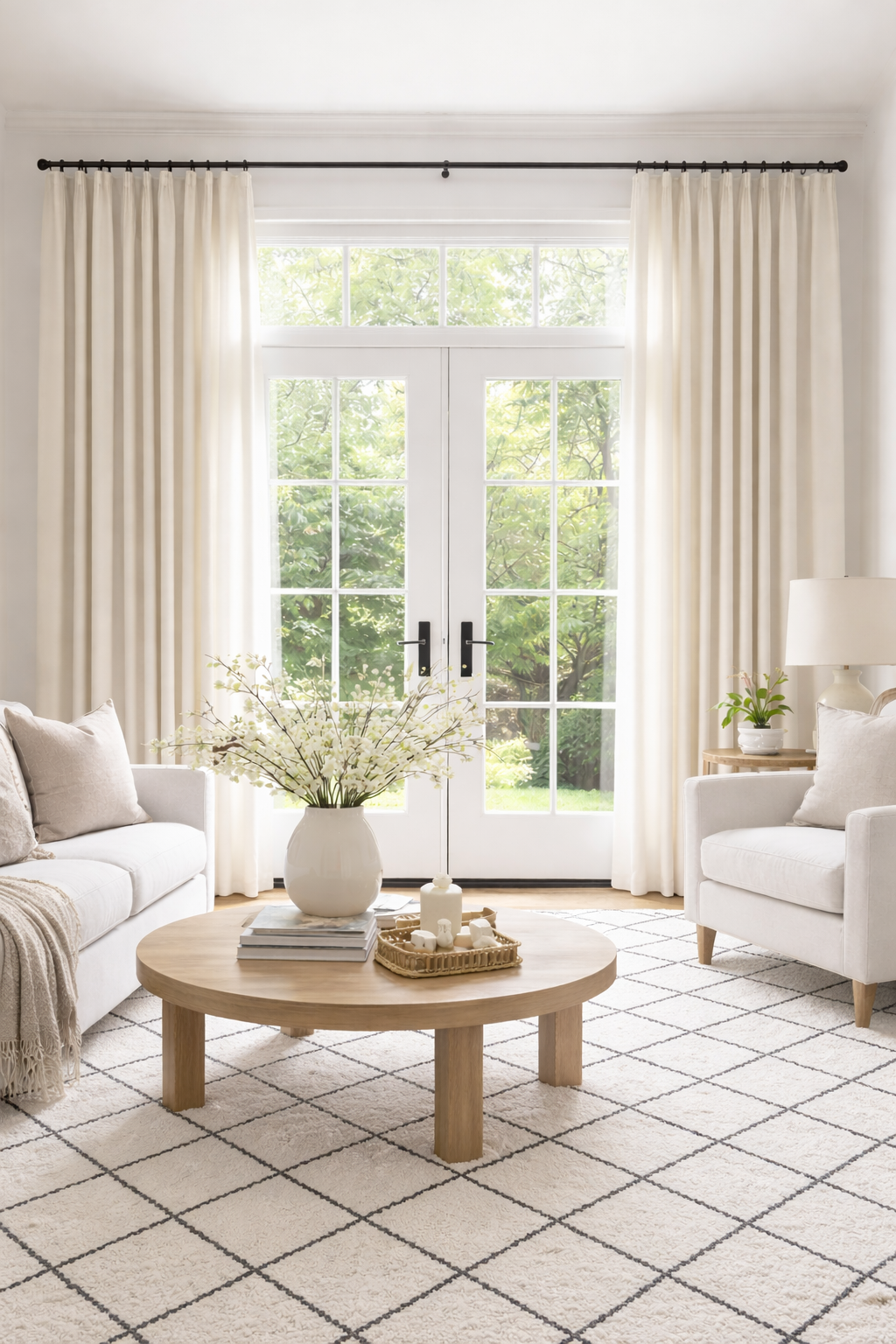
AI-generated rendering illustrating properly installed drapery hung high and wide, with full-length panels framing French doors and a balanced black-and-ivory diamond rug grounding the space.
Drapery has been part of my life for as long as I can remember. My mother was an interior designer who focused extensively on custom window treatments, working closely with my father. I grew up watching fabric selections, measuring appointments, and installations — and seeing firsthand how much precision and thought goes into doing it correctly.
Because of that background, I’ve always been especially attentive to how drapery is hung and proportioned. Over the years in my own design practice, I’ve noticed the same common mistakes repeated again and again — curtains hung too low, panels that are too short, rods that are too narrow, or fabric that lacks proper fullness.
These details may seem minor, but they dramatically impact how a room feels. Properly designed drapery can make ceilings appear taller, windows feel larger, and a space feel complete and intentional. Poorly executed drapery can visually shrink a room and disrupt its proportions.
This guide walks you through everything you need to know — from placement and sizing to fabric, hardware, and how to handle architectural windows like bays, arches, and sloped ceilings.
If you’ve ever questioned whether your curtains are hung correctly, this guide will give you clarity.
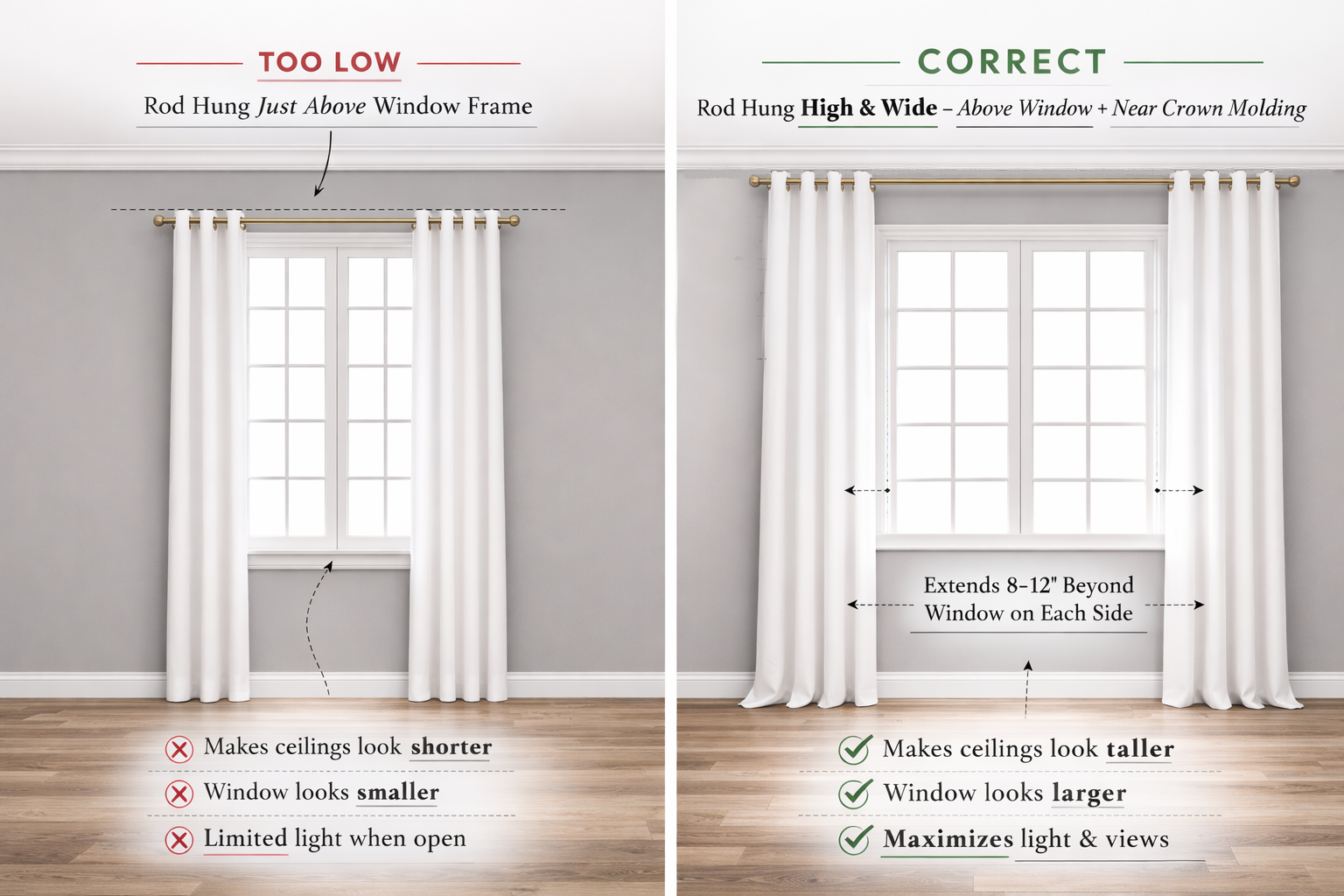
AI-generated comparison graphic showing incorrect drapery placement (rod hung too low and narrow) versus correct installation hung high and wide above the window for better proportion and light.
Where Should Drapery Be Hung?
One of the most common mistakes I see is placing the rod directly above the window frame. It feels logical, but it almost always makes the room look shorter.
Drapery should visually stretch a space, not compress it.
In most rooms, the rod should be mounted close to the ceiling. If there’s crown molding, install it just beneath the molding. In modern spaces without trim, position the rod a few inches below the ceiling line — or even at ceiling height if proportions allow.
That extra height draws the eye upward and subtly changes how the entire room feels.
Width matters just as much as height.
A rod that barely extends past the window frame will make the window look smaller and block natural light when the panels are open. Instead, extend the rod well beyond the window — often 8 to 12 inches on each side, sometimes more depending on scale. When the drapery is open, most of the fabric should sit off the glass.
And in larger rooms, don’t think only about the window. Think about the wall.
Sometimes it makes more sense to treat the entire wall as one architectural element and span the rod across a wider area. This creates balance and avoids the look of a narrow treatment floating awkwardly on a large surface.
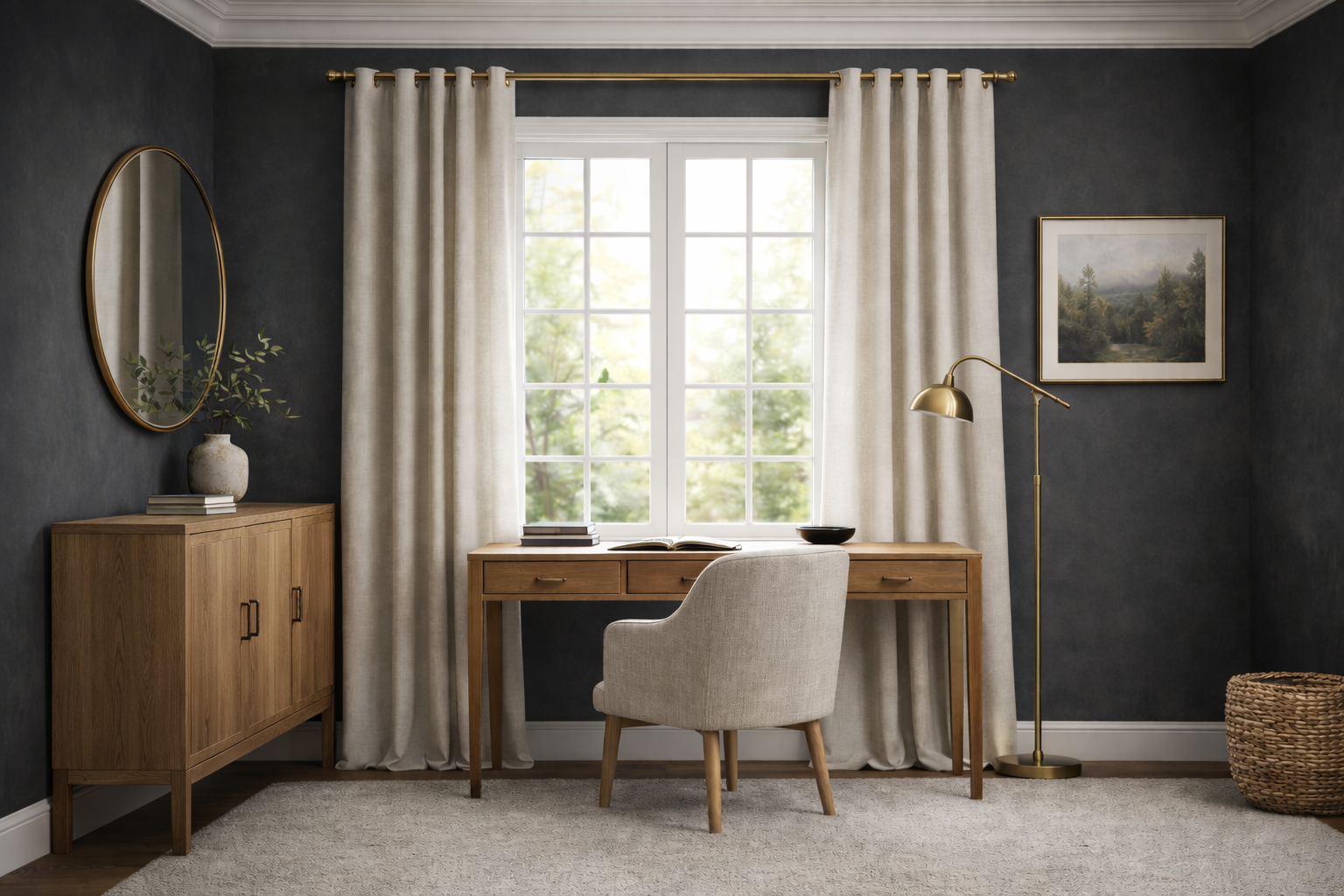
AI-generated rendering of a modern organic home office featuring floor-length linen drapery hung just below crown molding, softly kissing the floor for a clean, tailored finish.
Should Curtains Touch the Floor?
In almost every case, yes.
Curtains that hover above the floor tend to look unfinished, even when the rest of the room is beautifully designed. The gap draws attention in a way that feels accidental rather than intentional.
There are generally three ways drapery should meet the floor:
The “Kiss”
The hem lightly touches the floor. This is the most common and versatile option. It feels tailored and clean, and it works well in living rooms, bedrooms, and most everyday spaces.
The Slight Break
The fabric rests just slightly on the floor, creating a subtle fold. This works nicely in more relaxed interiors where you want softness without excess fabric.
The Puddle
The panels extend several inches beyond the floor and gather at the base. This can feel dramatic and elegant, particularly in formal spaces with high ceilings. However, it’s not ideal for high-traffic areas or homes with pets.
What almost never works is fabric that stops an inch or two above the floor. It visually shortens the wall and disrupts the vertical line you’ve created by hanging the rod higher.
If you want a deeper breakdown of how to choose the right curtain length for your space, I’ve covered that in more detail here: Should Curtains Touch the Floor?
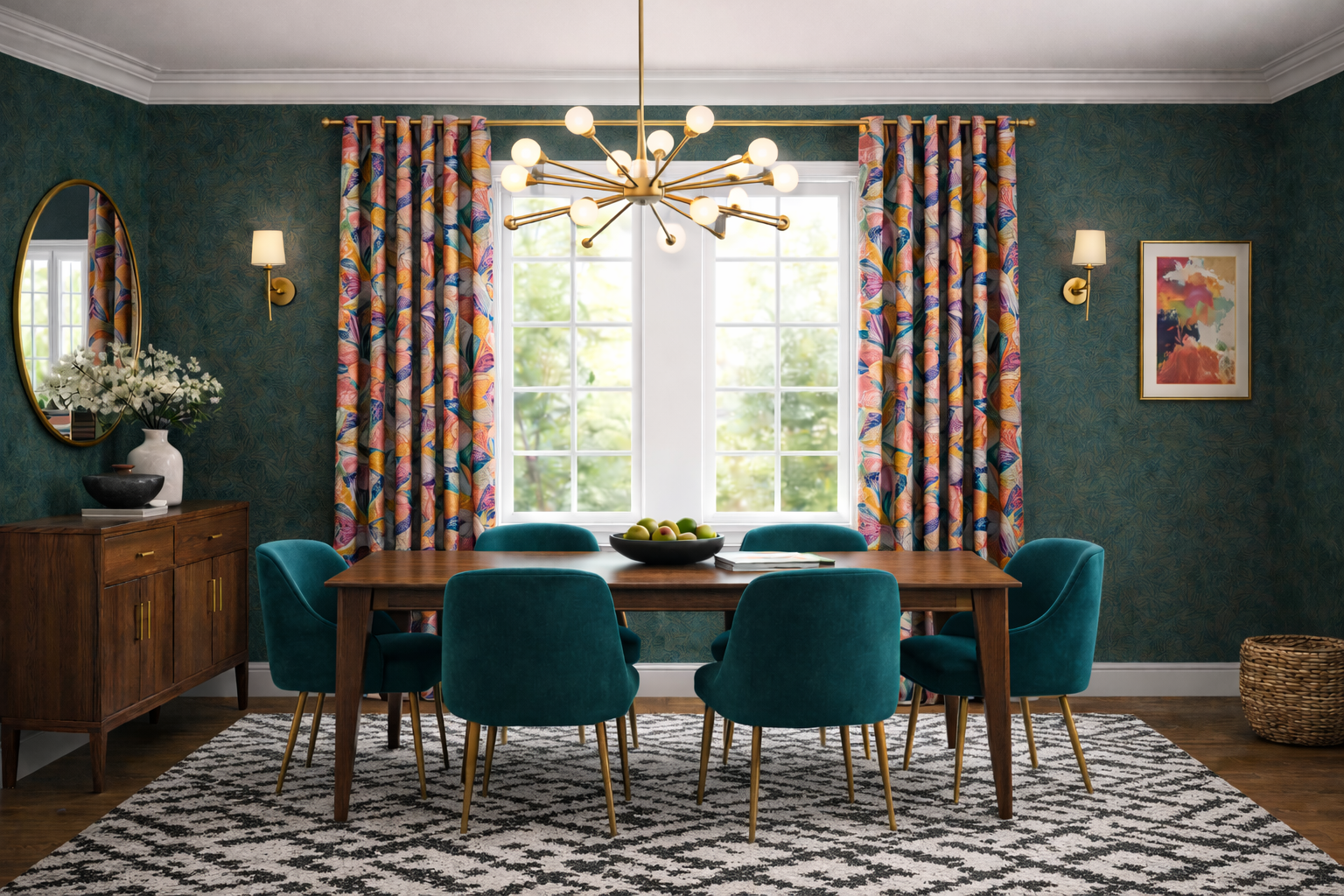
AI-generated mid-century glam dining room featuring patterned drapery panels installed with generous width for proper fullness and balance.
How Wide Should Drapery Be?
Drapery that isn’t wide enough will always look skimpy, no matter how beautiful the fabric is.
This is one of the most common mistakes I see in ready-made panels. The rod may be properly installed, and the length may be correct — but the panels don’t have enough fullness to create presence.
As a general guideline, drapery should measure 1.5 to 3 times the width of the window (or the span of the rod).
The exact amount depends on the look you want:
1.5x fullness creates a more tailored, minimal appearance.
2x fullness is the most common and works well in most interiors.
2.5x–3x fullness creates a richer, more luxurious look, especially with lighter fabrics or formal spaces.
If the panels are meant to close, you’ll need enough width to cover the entire span while still maintaining that fullness. If they’re purely decorative and remain open, they should still feel substantial when gathered to the sides.
Thin, flat panels that barely ripple when drawn open often make a room feel unfinished.
Don’t Forget Stack Back
Another factor many people overlook is “stack back” — the amount of wall space needed for the panels when they are fully open.
If the drapery is too narrow, it will cover part of the glass even when open. Proper width allows the panels to sit mostly off the window, preserving natural light and making the window feel larger.
In larger rooms or with wide picture windows, it often makes sense to treat the entire wall as one span rather than focusing narrowly on the window frame.
The goal is simple: the drapery should feel intentional and balanced, not like an afterthought.
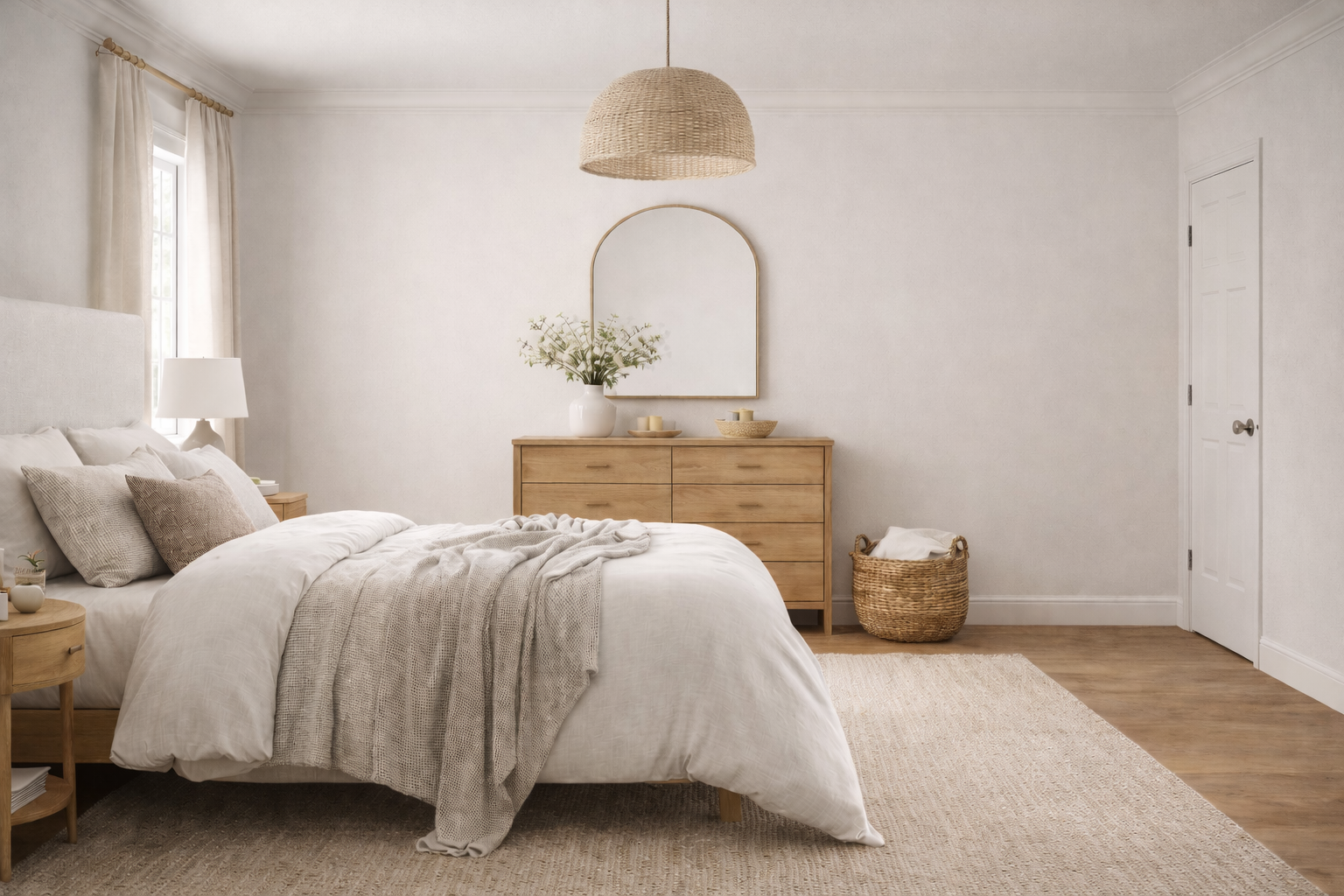
AI-generated Scandinavian-style bedroom showing functional drapery panels hung high below crown molding, designed to close fully for privacy and light control.
Functional vs. Decorative Drapery
Before selecting fabric or hardware, it helps to decide one thing:
Is the drapery meant to function, or is it primarily decorative?
The answer changes everything.
Decorative Panels
In many living rooms and dining rooms, drapery is installed to soften the space and frame the windows rather than to provide privacy or light control.
In these cases:
Panels may remain stationary.
The fullness still matters.
The fabric can be lighter since it doesn’t need to block light.
The primary goal is proportion and visual balance.
Even when decorative, the panels should look substantial. Thin panels hung only for appearance can make a space feel incomplete.
Functional Drapery
In bedrooms, media rooms, or homes with close neighbors, drapery often needs to close.
That means thinking about:
Proper width to allow full coverage
Lining for privacy or blackout
Hardware that can handle daily movement
Stack back space so the panels don’t crowd the glass
When drapery is functional, it needs to be designed differently. The wrong width or insufficient lining can lead to gaps, light bleed, or hardware strain over time.
Layered Treatments
In many homes, the best solution is layered.
For example:
A tailored Roman shade for privacy during the day
Drapery panels for softness and evening coverage
Layering allows you to control light throughout the day while maintaining architectural balance.
The key is intention. Drapery shouldn’t be installed simply because “that’s what you do.” It should serve a purpose — whether that’s filtering light, providing privacy, improving acoustics, or completing the design.
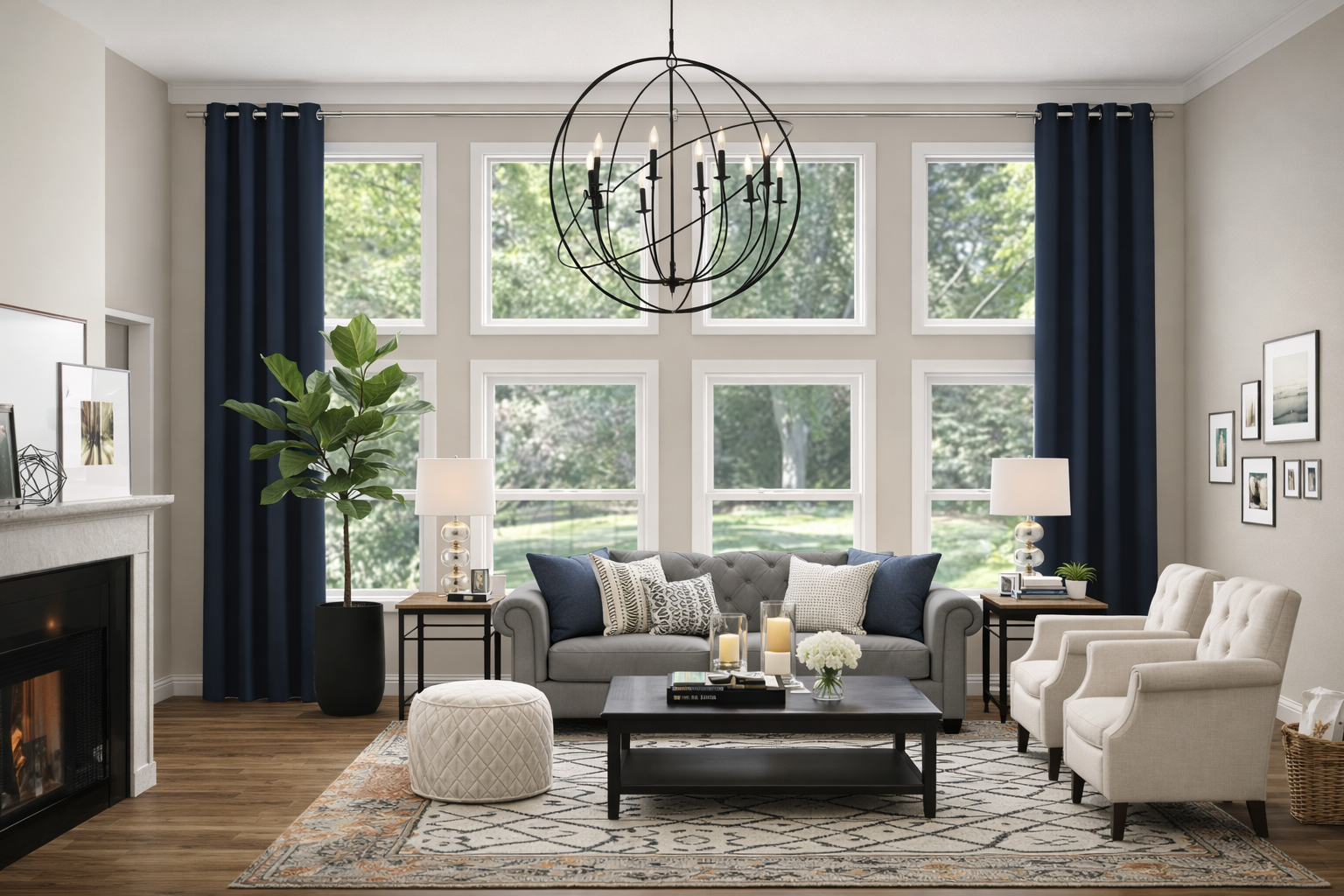
AI-generated 3D rendering inspired by Joshua’s original design concept, showing navy drapery panels with proper fullness and lining in a two-story living room.
Fabric and Lining Choices
Fabric changes everything.
The same window can feel airy and relaxed in linen, structured and tailored in cotton, or dramatic and refined in velvet. The choice isn’t just about color — it affects how the panels hang, how they filter light, and how the room feels overall.
Fabric Weight and Drape
Lightweight fabrics such as linen or linen blends create softness and movement. They work beautifully in living rooms or spaces where filtered light is welcome.
Medium-weight fabrics offer more structure and privacy while still feeling versatile.
Heavier fabrics like velvet add richness and insulation, especially in bedrooms or formal spaces.
What matters most is how the fabric falls. A fabric that collapses or lacks body can make even properly measured panels look underwhelming.
Why Lining Matters
Lining is often overlooked, but it makes a significant difference.
A properly lined panel:
Hangs more smoothly
Protects the face fabric from sun exposure
Improves privacy
Adds weight so the panels fall cleanly
For bedrooms or bright exposures, blackout lining may be necessary. In other rooms, a standard privacy lining is usually sufficient.
Unlined drapery can work in very specific situations, but in most cases, lining improves longevity and appearance.
Sheer vs. Opaque
Sheer panels soften a room without blocking light. They work especially well layered behind heavier drapery or in spaces where privacy is not a concern.
Opaque fabrics provide more control and feel more substantial. The right choice depends on the function of the room and how much light you want to filter.
Fabric selection should feel intentional, not purely decorative. The goal is to balance light, proportion, and longevity.
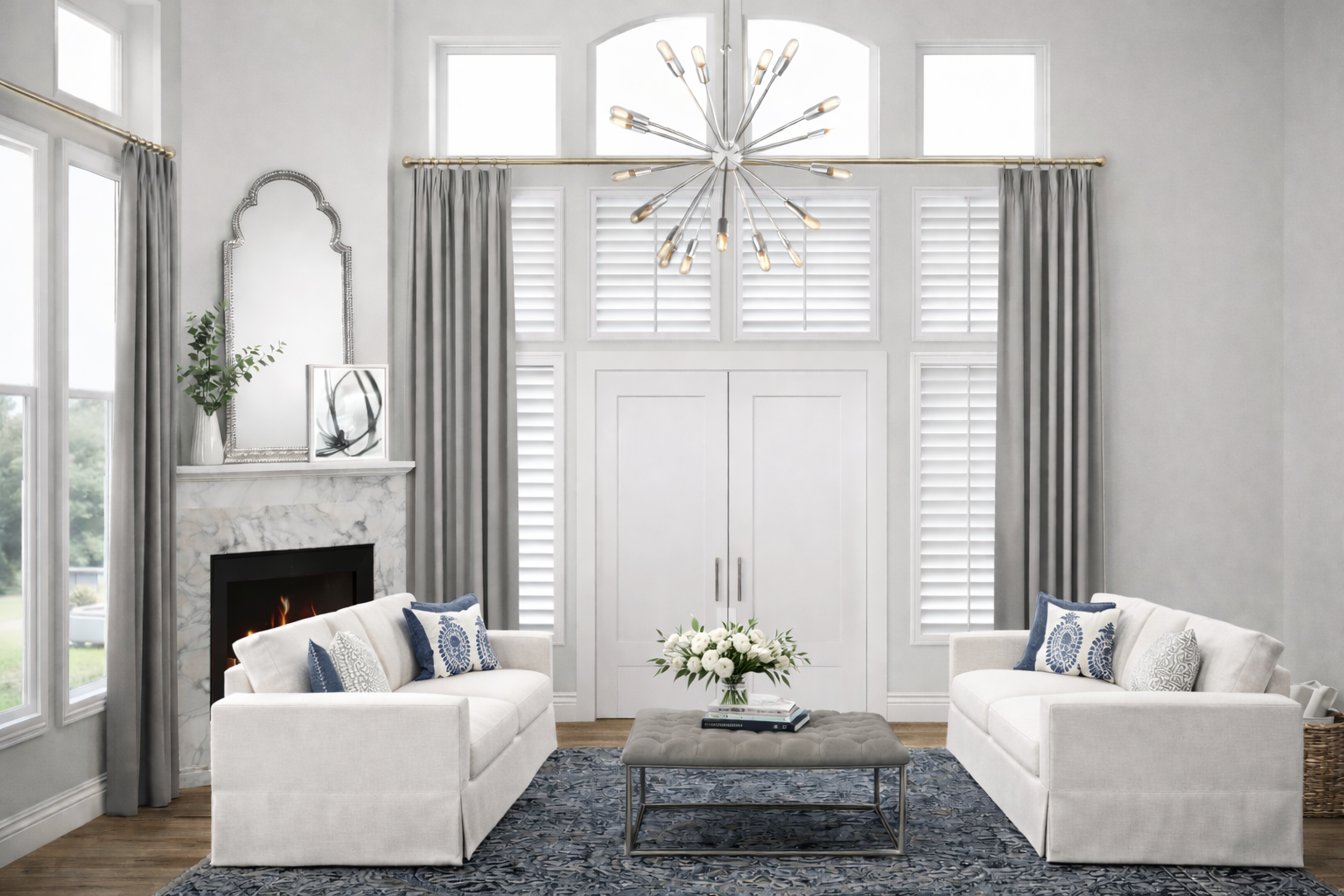
AI-generated 3D rendering inspired by Joshua’s original design, featuring pleated gray drapery panels on a brass rod with rings, demonstrating classic hardware and tailored pleat styling.
Hardware and Pleat Styles
Hardware is not just a support system. It’s part of the design.
The rod, brackets, and pleat style all influence how polished the final result feels. Even well-measured panels can look underwhelming if the hardware is too small or stylistically disconnected from the room.
Rod Size and Proportion
The diameter of the rod should relate to the scale of the room and the weight of the fabric.
In larger spaces or with heavier drapery, a more substantial rod prevents the installation from looking delicate or undersized. In smaller rooms with lighter fabric, a slimmer profile may feel more appropriate.
The goal is balance. Hardware should feel intentional — not like it was selected as an afterthought.
Finials and End Caps
Finials can add character, especially in traditional or transitional interiors. In more modern spaces, minimal end caps or clean-lined rods may feel more aligned with the architecture.
There isn’t a universal right answer here. What matters is consistency with the overall design direction.
Pleat Styles
The top of the drapery panel affects how the fabric hangs and how tailored it appears.
Pinch pleats create structure and a more custom look. Ripple fold offers a clean, contemporary feel. Grommet panels tend to feel more casual and can sometimes limit how elevated the final result looks.
If you're unsure which drapery header style is right for your home, I've created a detailed guide that compares pinch pleat, Euro pleat, goblet pleat, box pleat, inverted box pleat, ripple fold, grommet, ring top, rod pocket, and more. Read my Complete Guide to Drapery Headers to learn how each style affects the appearance, functionality, and overall feel of your window treatments.
The right choice depends on the room, the architecture, and how often the drapery will be opened and closed.
Functionality and Installation
If the panels are meant to move regularly, hardware quality matters. Brackets should be securely anchored, and rods should be rated for the fabric weight.
Drapery should glide smoothly. If it drags or strains the hardware, something wasn’t designed correctly.
Well-executed hardware allows the drapery to feel effortless.
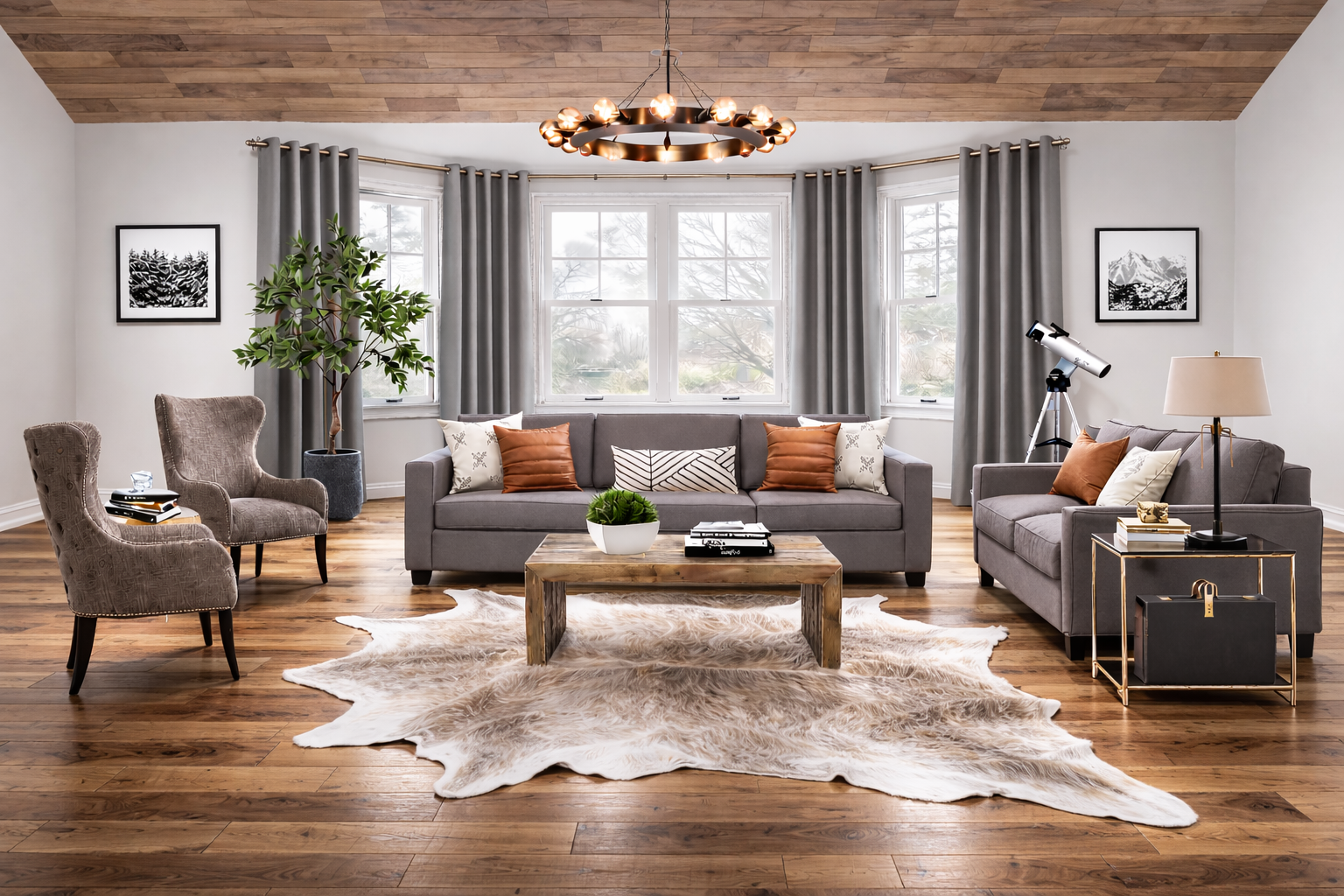
AI-generated 3D rendering inspired by Joshua’s original design, featuring a three-sided bay window with continuous curtain rod and full-length gray drapery panels installed between each window section.
Bay Windows
Bay windows should be treated as one architectural feature, not three separate windows.
This is where many installations go wrong.
For a typical three-window bay, using one narrow panel per window almost always feels underdressed. The result looks segmented and lacks presence.
Instead, I generally recommend one of the following approaches:
• A minimum of four panels — two narrower panels placed at the outer edges and two wider panels toward the center
• Or a pair of panels for each window when scale allows and a fuller look is desired
Both approaches create balance and give the bay enough visual weight.
The outer panels anchor the entire composition, while the inner panels soften the transitions between angles. When standing back, the bay should feel framed as a whole — not divided into three unrelated parts.
Hardware Considerations
In many cases, a rod that follows the angle of the bay creates continuity. This keeps the drapery visually connected across all three windows.
If separate rods are used, proportions must remain consistent so the installation doesn’t feel fragmented.
Function vs. Decoration
If the panels are decorative, they can remain mostly stationary and frame the outer edges.
If they need to close, allow sufficient stack back at each return so the panels do not crowd the glass when open. Bay windows benefit from generous fabric — not minimal coverage.
The guiding principle is scale. Bay windows require more fabric than most people initially expect.
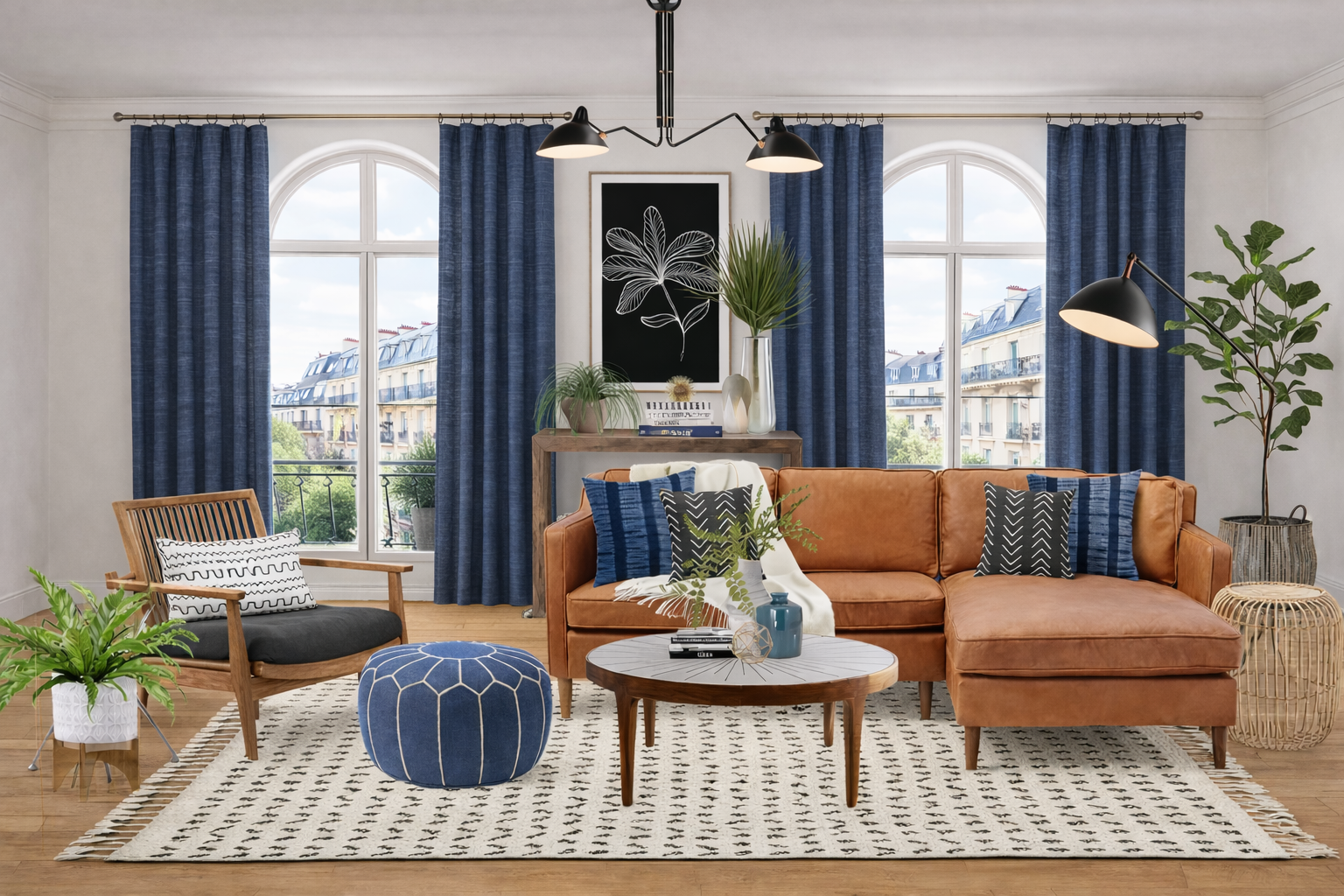
AI-generated rendering inspired by Joshua Jones’ modern eclectic living room design, featuring arched windows with full blue drapery panels and a cognac leather sectional.
Drapery for Architectural Windows
Not every window is straightforward. Arches, slopes, tall walls, and corner installations require a slightly different approach. The goal isn’t just to “cover the window,” but to respect the architecture while maintaining balance in the room.
Arched Windows
Arched windows are often beautiful focal points. Covering the entire shape can sometimes diminish what makes them special.
In many cases, it works well to mount the rod below the arch and leave the curved portion exposed. This preserves the architectural detail while still allowing for privacy and softness below.
If full coverage is necessary — for light control or privacy — custom solutions may be required. The proportions need to feel intentional, not forced. The drapery should complement the arch rather than compete with it.
When in doubt, step back and ask: does the window need coverage, or does it need framing?
Sloped or Angled Ceilings
Windows placed beneath sloped ceilings can be visually challenging.
Mounting the rod parallel to the slope may seem logical, but it can sometimes exaggerate the angle and feel unbalanced. In many situations, installing a level rod aligned with the straight ceiling plane creates a cleaner result.
The choice depends on the room’s proportions. The drapery should stabilize the space, not amplify the irregularity.
Tall or Two-Story Windows
With tall windows, scale becomes everything.
The rod should be mounted as high as possible, and the panels need enough width and weight to hold their own against the height of the wall. Undersized panels can make tall windows feel awkward rather than dramatic.
In some cases, extremely tall operable panels are impractical. Layering motorized shades with stationary drapery can provide a more functional solution while preserving visual impact.
Corner Windows
Corner windows benefit from continuity. A wraparound rod can soften the transition and keep the treatment cohesive.
Separate rods can work, but they often create visual breaks that interrupt the flow of the room. The goal is to maintain rhythm and avoid unnecessary segmentation.
Large Picture Windows
For wide picture windows, it’s helpful to think beyond the glass and consider the entire wall.
Treating the full span as one architectural feature often produces the strongest result. Generous stack back allows the panels to sit mostly off the window when open, preserving natural light and making the opening feel expansive.
Scale and proportion matter even more with large windows. The drapery should feel substantial enough to support the width.
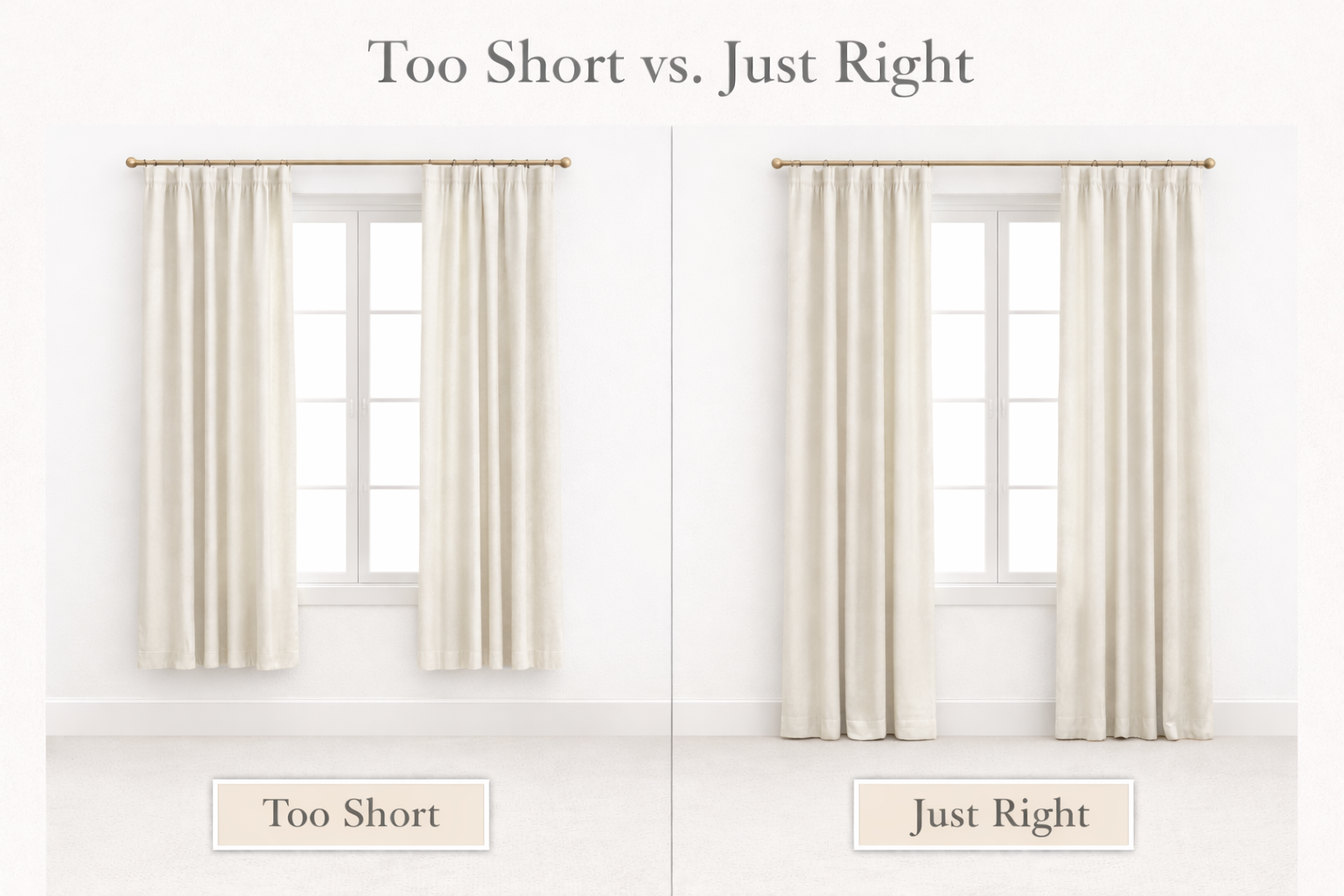
AI-generated comparison graphic showing the difference between curtains that hang too short and curtains that properly touch the floor.
Common Drapery Mistakes to Avoid
Even beautiful fabric can look wrong if the proportions aren’t carefully considered. Over the years, I’ve seen a few patterns repeat themselves.
Hanging the Rod Too Low
Mounting the rod just above the window frame is one of the fastest ways to visually shorten a room. Drapery should elevate the architecture, not compress it.
Panels That Are Too Short
Curtains that hover above the floor often feel unfinished. Unless there is a very specific reason, panels should meet the floor in a clean, intentional way.
Not Enough Fullness
Flat, skimpy panels can make a window look underdressed. Drapery needs volume to feel substantial. Without it, even high-quality fabric can fall flat.
Narrow Rods
A rod that barely extends beyond the window frame restricts light and makes the window feel smaller. Proper extension allows the panels to frame the opening rather than cover it.
Ignoring Scale
Large walls require more generous treatments. Tall ceilings need longer panels. Oversized windows demand proportionate width. When scale is overlooked, the entire room can feel slightly off.
Most of these mistakes aren’t dramatic on their own — but together, they subtly undermine a space.
Drapery should feel considered, balanced, and aligned with the architecture of the room.
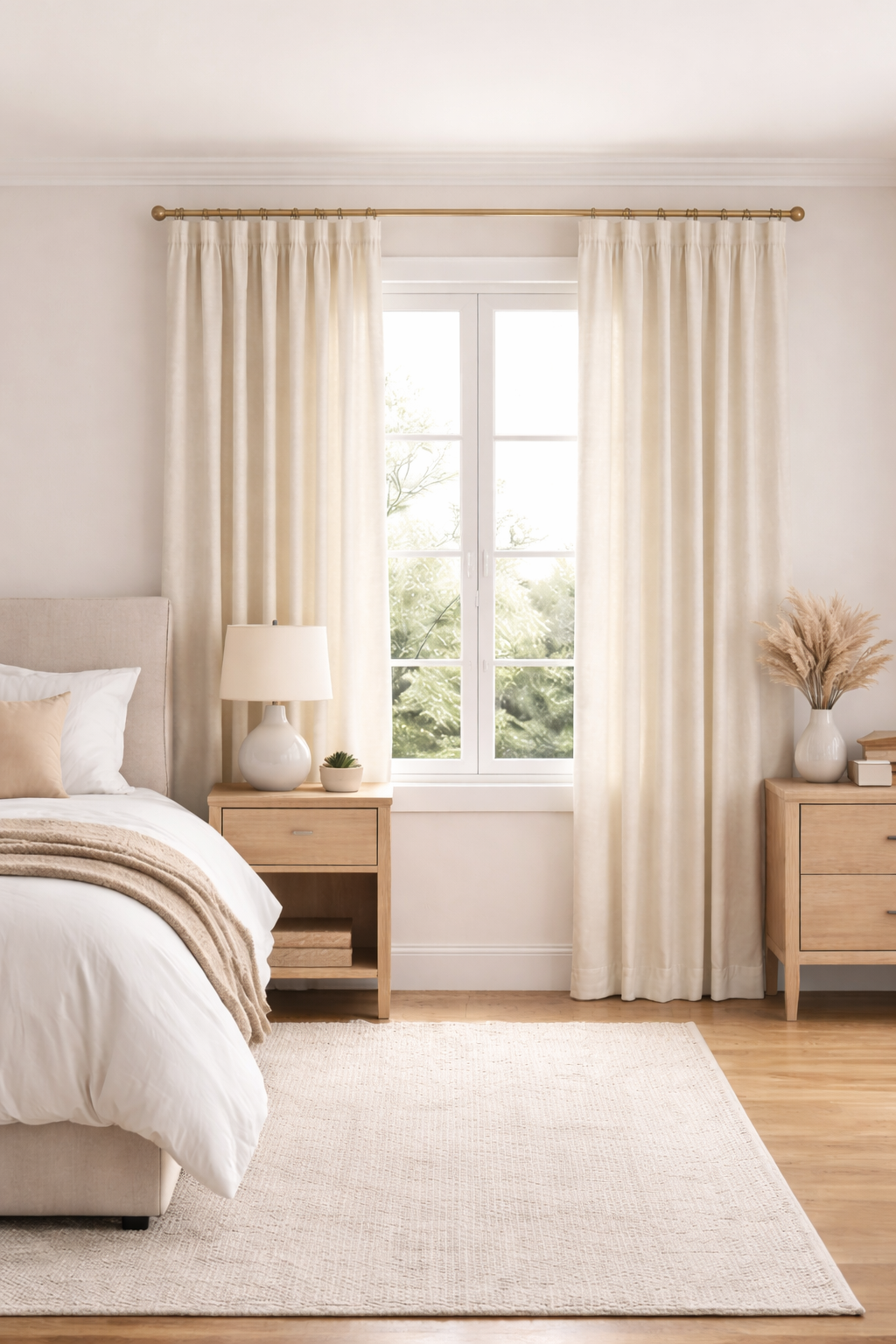
AI-generated rendering of a serene modern organic bedroom featuring floor-length linen drapery that gently touches the floor for a polished, timeless finish.
Why Drapery Deserves Attention
Drapery is often one of the last decisions made in a room, but it has one of the biggest visual impacts.
When it’s installed with care — at the right height, with proper width, and in proportion to the architecture — it quietly elevates everything around it. The ceilings feel taller. The windows feel larger. The room feels finished.
When it’s rushed or treated as an afterthought, the imbalance is noticeable, even if you can’t immediately explain why.
Good drapery doesn’t demand attention. It simply supports the room in a way that feels natural and complete.
And that’s the goal.
If you’re planning a renovation, building a new home, or simply unsure how to approach your windows, this is something I regularly guide clients through.
Through my virtual interior design services, I help homeowners make thoughtful decisions about window treatments — from proportion and placement to fabric and hardware selection — so the final result feels balanced and intentional.
Window treatments shouldn’t feel like an afterthought. When integrated properly into the overall design plan, they become part of the architecture of the room.