Ask Joshua: Should I Do an Accent Ceiling (or Will I Regret It)?
Hi Joshua,
My partner and I have been discussing the idea of adding an accent ceiling to make more of a statement in our main living area, which includes the foyer, living room, dining room, kitchen, and family room. It’s all one open-concept space, and we’re planning to keep the walls in a neutral color but go a bit bolder with the ceiling.
Our ceilings are 9 feet tall and completely flat—no vaults or tray details. We’re hoping to make our home feel a little more unique compared to the rest of our neighborhood, which tends to feel pretty cookie-cutter.
We love your work and would really value your thoughts. Do you think this is a good idea, or could it end up feeling like too much?
Much thanks,
Melissa - Mission Viejo, California
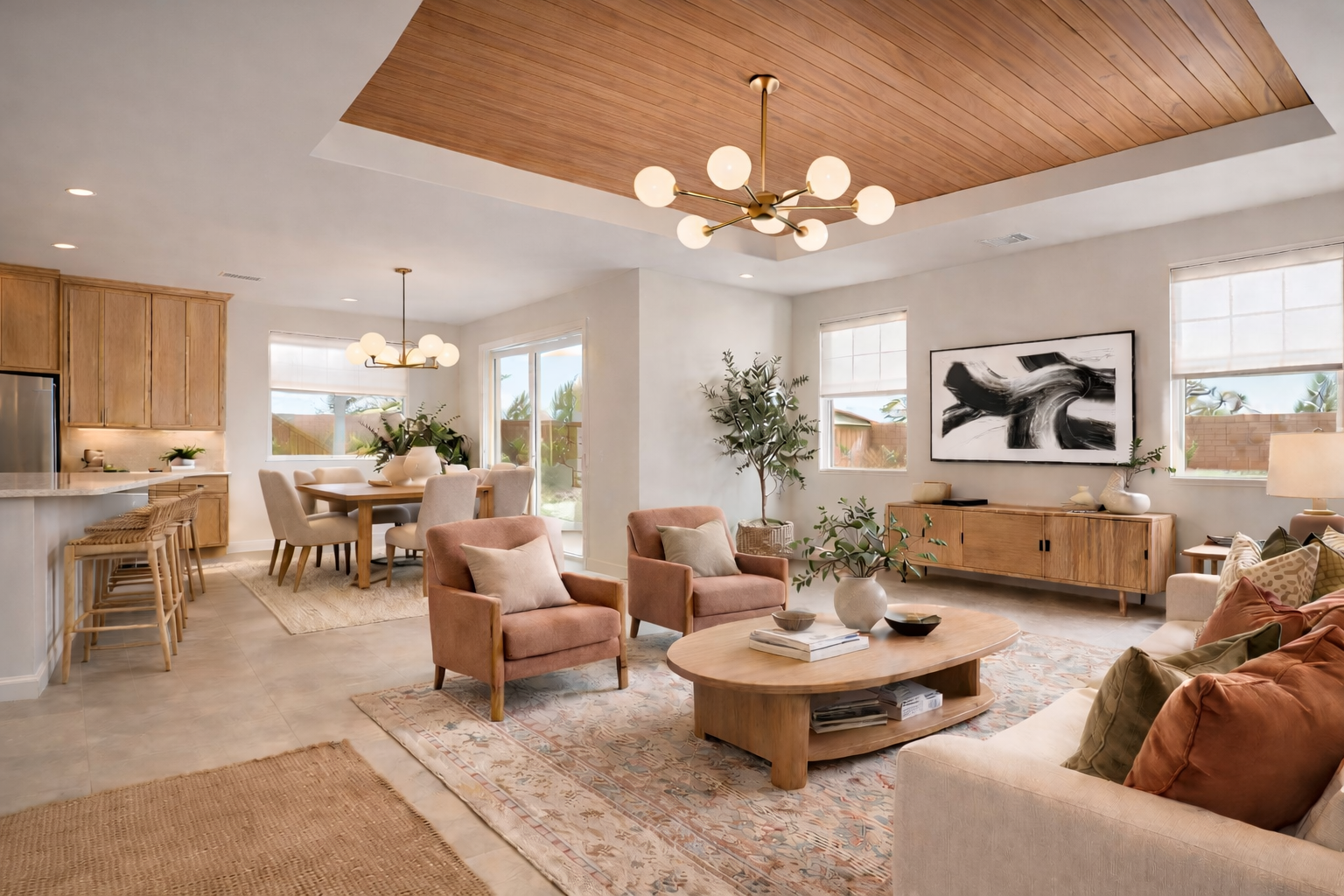
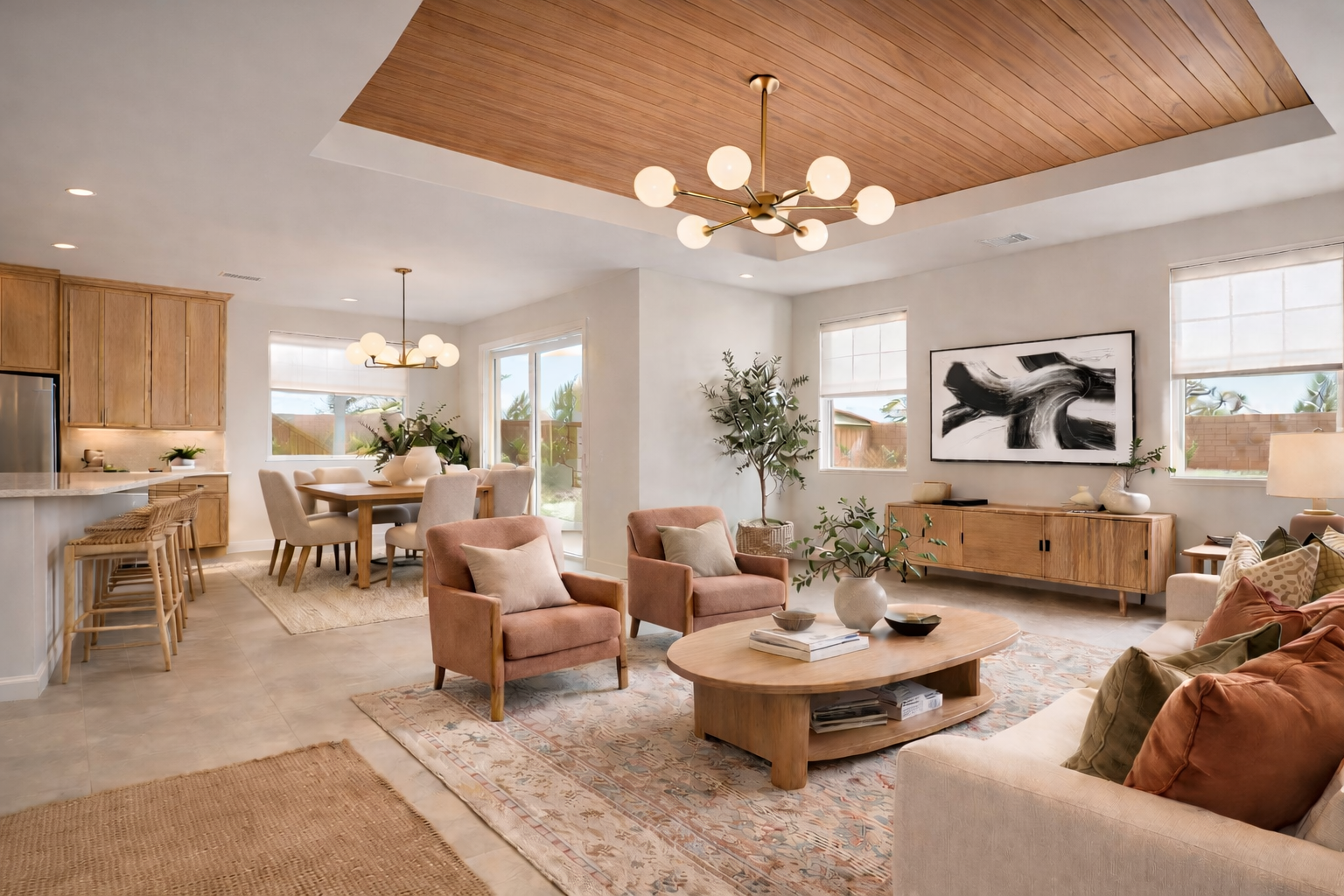
A targeted wood accent ceiling defines the living room zone within an open-concept space without overwhelming the entire ceiling. AI-generated image.
Hi Melissa,
I completely understand the desire to make your home feel different—especially in a neighborhood where everything starts to look the same. An accent ceiling can absolutely achieve that, but this is one of those design decisions where the difference between “wow” and “why did I do this?” comes down to how controlled the execution is.
Since your entire main living area is open concept and your ceilings are a standard 9 feet, I would be careful about going too bold across the entire ceiling plane. In a large, continuous space like yours, the ceiling isn’t just a feature—it becomes the dominant visual element. If it’s too heavy or too dark, it can start to visually lower the ceiling and make the space feel more compressed than you intended.
That said, I’m not against the idea at all. I just wouldn’t treat the entire ceiling the same way.
A much stronger approach is to be intentional about where the accent actually lives. For example, defining one zone—like the dining area or living room—with a ceiling treatment can create a focal point without overwhelming the entire space. This works especially well in open layouts because it helps visually organize the room without adding walls.
If you’re leaning toward paint, I would stay within a controlled range—something slightly deeper than your wall color or a soft contrast rather than a dramatic, saturated tone. This keeps the look elevated instead of trendy. If you’re thinking about wood, beams, or paneling, scale and spacing become critical. Oversized or overly busy patterns on a 9-foot ceiling can quickly feel heavy.
Another thing to think about is lighting. Once you add an accent ceiling, every light fixture, can light, and shadow becomes more noticeable. Done right, it enhances the design. Done poorly, it highlights inconsistencies.
So will you regret it? You might—if you try to make the entire ceiling the statement.
But if you treat it as a targeted design feature and keep the execution refined, it can add just enough personality to set your home apart in a really thoughtful way.
This is one of those moments where restraint will give you a much stronger result than going all in.
Warmly,
Joshua
Have interior design related questions? You can ask Joshua here.