

Ask Joshua: Are Pot Fillers Worth It? Pros and Cons to Consider
Hi Joshua,
I am planning to expand my kitchen this fall and have been gathering inspiration for the renovation. I have always wanted a pot filler above the range, but I have noticed that some newer kitchens—including high-end designs—do not include one.
Are pot fillers becoming outdated? What are the advantages and disadvantages, and how can I decide whether one is worth adding to my kitchen?
Thank you,
Kate - Atlanta, Georgia
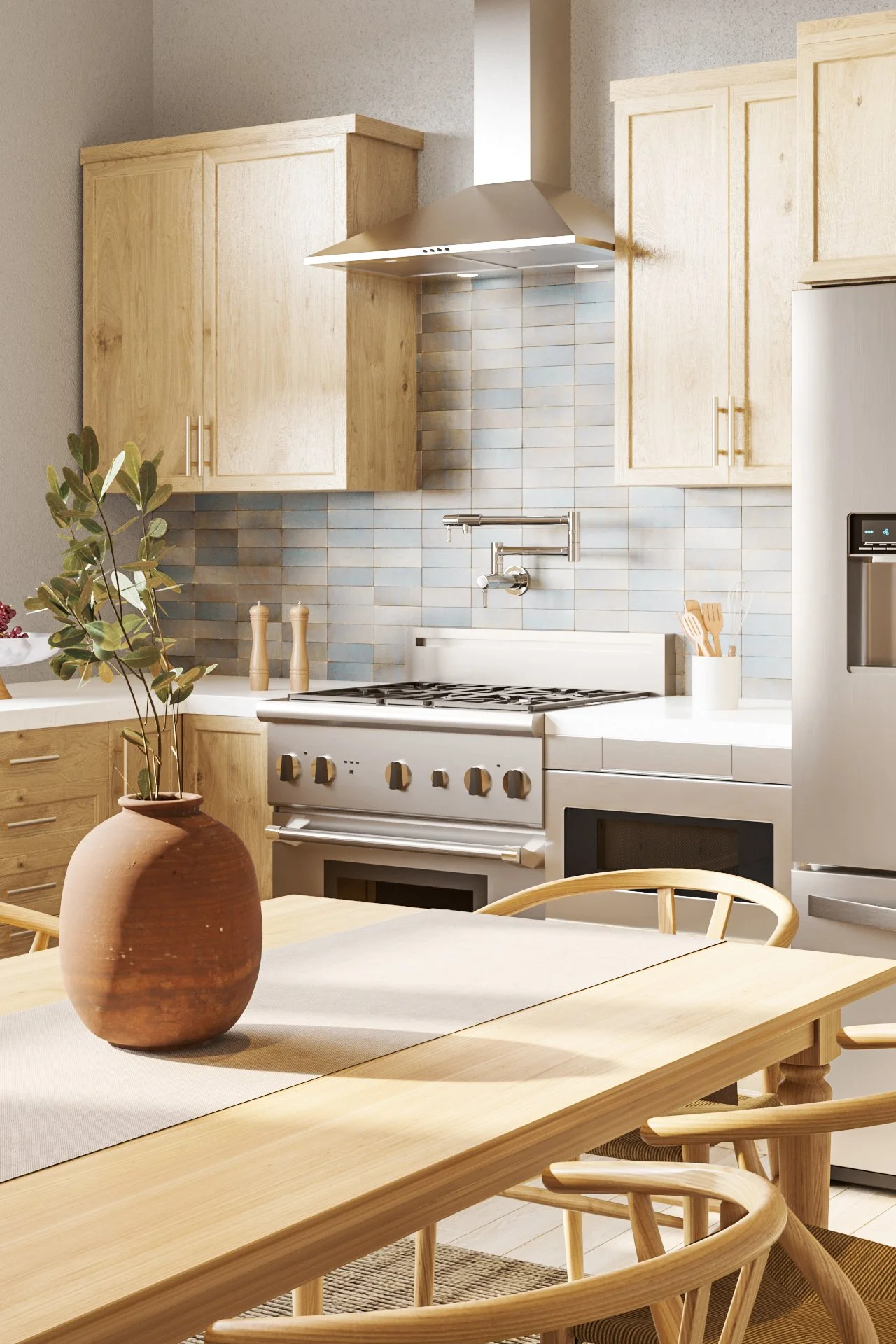
A Scandinavian-style kitchen with natural wood cabinetry, a wall-mounted pot filler, and a softly colored tile backsplash, designed by virtual interior designer Joshua Jones of JJones Design Co.
Hi Kate,
Thank you for writing in. Pot fillers are neither essential kitchen features nor design mistakes. Their value depends less on whether they are currently popular and more on how frequently you cook, the location of your sink, and whether the convenience justifies the additional plumbing and maintenance.
A pot filler is a wall-mounted cold-water faucet installed near the range. Its articulated arm extends over a pot for filling and folds against the wall when it is not in use. It can be a practical addition for some households, but it is not automatically worthwhile simply because it appears in a luxury kitchen.
What Are the Advantages of a Pot Filler?
It Reduces the Need to Carry Full Pots to the Range
The primary advantage is convenience. You can place an empty pot on the burner and fill it there instead of carrying a heavy pot of water from the sink to the range.
This may be particularly useful if you frequently prepare pasta, stock, soup, boiled seafood, or other foods that require large quantities of water. It can also help someone who finds lifting and carrying a full pot difficult.
However, a pot filler eliminates only the first part of the trip. Unless the kitchen includes another appropriate way to drain the pot, you will still need to carry it to the sink after cooking.
It Can Accommodate Tall or Oversized Pots
Some large stockpots do not fit comfortably beneath a kitchen faucet, particularly when the sink is shallow or the faucet has limited clearance. A pot filler provides more open space for filling tall cookware.
It can also be helpful when the primary sink is located on an island or some distance from the range.
It Creates a Second Source of Water
A second faucet can improve efficiency when more than one person is using the kitchen. Someone can fill a pot at the range while another person washes produce, prepares food, or cleans dishes at the sink.
Whether this is genuinely useful will depend on how often multiple people cook together and the size of the kitchen.
It Can Add a Decorative Detail
A well-selected pot filler can complement the range, hood, cabinet hardware, and other plumbing fixtures. It may introduce a beautiful metallic finish and help the cooking area feel thoughtfully designed.
However, appearance alone may not justify the expense. If you expect to use it only occasionally, consider whether the same budget could make a greater difference elsewhere in the kitchen.
What Are the Disadvantages of a Pot Filler?
There Is No Drain Beneath It
Unlike the faucet at your sink, a pot filler is installed above the range without a drain below it. A slow drip, loose connection, accidental overflow, or faucet failure could allow water to reach the cooking surface, cabinetry, wall, or floor.
This does not mean that every pot filler will leak, but the consequences can be more significant because there is no sink to contain the water. A fixture with two shutoff valves provides an additional point of control, but it does not eliminate the possibility of a plumbing problem.
Choose a high-quality fixture, have it installed by a qualified plumber, and make sure you know where the water supply can be shut off if necessary. Installation requirements vary by model, so the plumber should follow the fixture manufacturer’s instructions and all applicable local plumbing requirements.
You Still Need to Carry the Pot to the Sink
A pot filler makes it easier to fill a pot, but it does not help you empty one. After cooking pasta or another food that needs draining, you will still carry a heavy—and now hot—pot to the sink.
For some homeowners, this makes the convenience feel incomplete. Consider the entire cooking process rather than only the initial trip from the sink.
Discolored Water Can Be Difficult to Flush
If water-main repairs, pipeline construction, hydrant use, or other utility work occasionally causes brown or discolored water in your area, that water may also reach the pot filler.
At a kitchen sink, you can let the faucet run directly into the drain until the water becomes clear. A pot filler has no drain beneath it, so flushing the line requires filling containers and repeatedly carrying them to the sink. You also may not notice the discoloration immediately if you begin filling a pot that already contains food.
This could introduce sediment or discolored water into a meal while you are cooking. If temporary water-quality issues are common in your neighborhood, the inability to flush a pot filler conveniently is an important reason to reconsider installing one.
Installation Adds Expense
A pot filler requires a dedicated cold-water supply within the wall. The project may also involve opening and repairing the wall, adding structural support for the fixture, modifying the backsplash, and hiring a plumber.
Installation is usually easiest and most economical during a complete kitchen renovation, before the wall and backsplash are finished. Adding one to an existing kitchen can be considerably more disruptive.
It Requires Regular Cleaning
Because the fixture sits close to the cooking surface, it may collect grease, steam residue, and food splatters. The folding arm and multiple joints create additional areas that need to be cleaned.
Certain finishes show fingerprints and water spots more readily than others. Consider how the pot filler’s finish will age and whether its care requirements suit the way you maintain your kitchen.
Infrequent Use Can Make It Less Practical
If you rarely boil water or use large cookware, the pot filler may become an expensive decorative feature. Water can also remain in a supply line that is not used regularly, so an infrequently used fixture should be flushed periodically.
I would not assume that a pot filler will rust merely because it is seldom used. Corrosion depends on the fixture’s materials, finish, water conditions, installation, and maintenance. A well-made fixture that is properly installed, cleaned, and operated should perform differently from a lower-quality product.
It Can Interrupt the Backsplash
A decorative backsplash may be an important focal point behind the range. Adding a faucet and plumbing connection can interrupt a stone pattern, tile layout, mural, or prominent area of veining.
Plan the pot filler at the same time as the range, hood, and backsplash. This will allow the tile installer or fabricator to position the opening intentionally instead of cutting into the finished material later.
How Should a Pot Filler Be Positioned?
The correct placement depends on the range, faucet dimensions, and cookware you use. It should be high enough to clear your tallest pot but low enough to reach and operate comfortably.
The faucet must also extend far enough to reach the appropriate burners and fold completely against the wall without hitting the hood, backsplash ledge, shelving, or other features.
Before installation, place your tallest commonly used pot on the range and coordinate the dimensions with your plumber, contractor, and backsplash installer. Do not choose the location based on a general measurement found online because ranges and pot fillers vary.
The controls should remain accessible without requiring you to reach dangerously across a hot burner. Review the proposed position carefully and never operate the fixture while an open flame or hot burner makes it unsafe to reach.
Is a Pot Filler Worth Adding to Your Kitchen?
A pot filler may be worthwhile if:
You frequently cook with large pots of water.
Your sink is far from the range.
Tall cookware does not fit easily beneath your primary faucet.
Carrying full pots from the sink is physically difficult.
More than one person regularly works in the kitchen.
You are already renovating and can install the plumbing before finishing the wall.
Temporary discoloration of your water supply is uncommon.
You may prefer to skip it if:
You rarely use large pots.
The sink is immediately beside or across from the range.
Brown or discolored water sometimes occurs during utility work in your area.
You want to minimize plumbing fixtures and potential maintenance.
The renovation budget would be better spent on ventilation, lighting, storage, or another frequently used feature.
You do not want the faucet to interrupt a special backsplash.
You are mainly considering it because it appears in other kitchens.
My recommendation is not to let its presence or absence in current kitchen photographs make the decision for you. If you have wanted a pot filler because it would support the way you genuinely cook, your renovation is the ideal time to consider one. Choose a quality fixture and coordinate its installation carefully with the range, hood, plumbing, and backsplash.
If you are attracted primarily to its appearance and cannot identify how often you would use it, I would probably invest that portion of the budget in a feature that improves the kitchen every day.
If you need help deciding which features deserve space in your renovation budget, my virtual interior design service can help. I can create a personalized kitchen design that considers your cooking habits, layout, storage needs, finishes, and long-term priorities.
I hope this helps you decide whether a pot filler would be a useful addition to your new kitchen or simply one more fixture to maintain.
Warmly,
Joshua
Have interior design related questions? You can ask Joshua here.