
Ask Joshua: How to Start a Gallery Wall When You Don’t Own Any Art
Hi Joshua,
I love the gallery walls I have seen in friends’ homes, magazines, and several of your interior design projects. I recently moved into my first place, and my living room has a large empty wall that would be perfect for one.
The problem is that I do not own any artwork yet, so I have no idea where to begin. How should I choose the art, sizes, frames, and overall arrangement? Are there any gallery-wall rules I should follow before I start shopping?
Thank you,
Nicole - New York City, New York
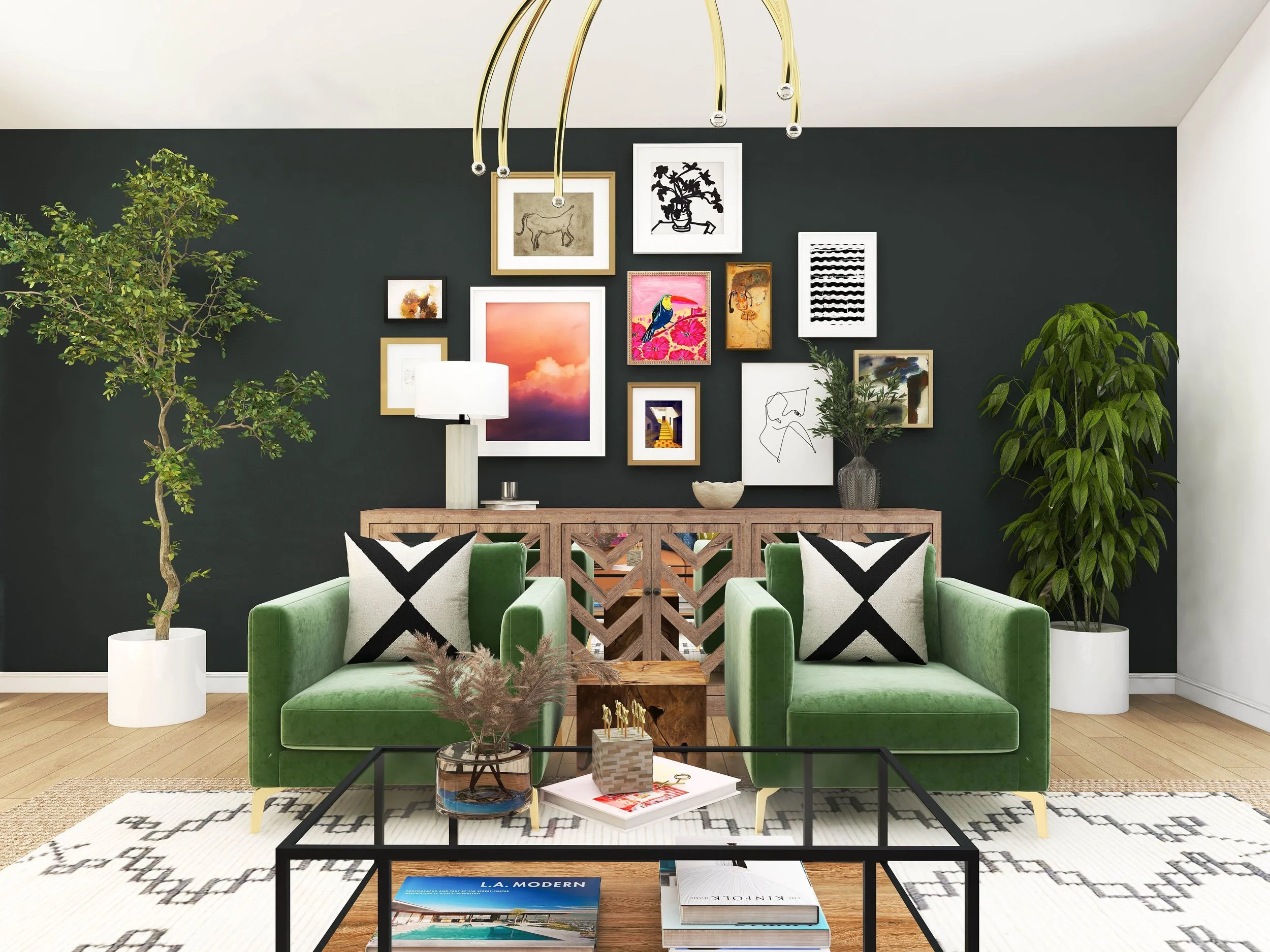
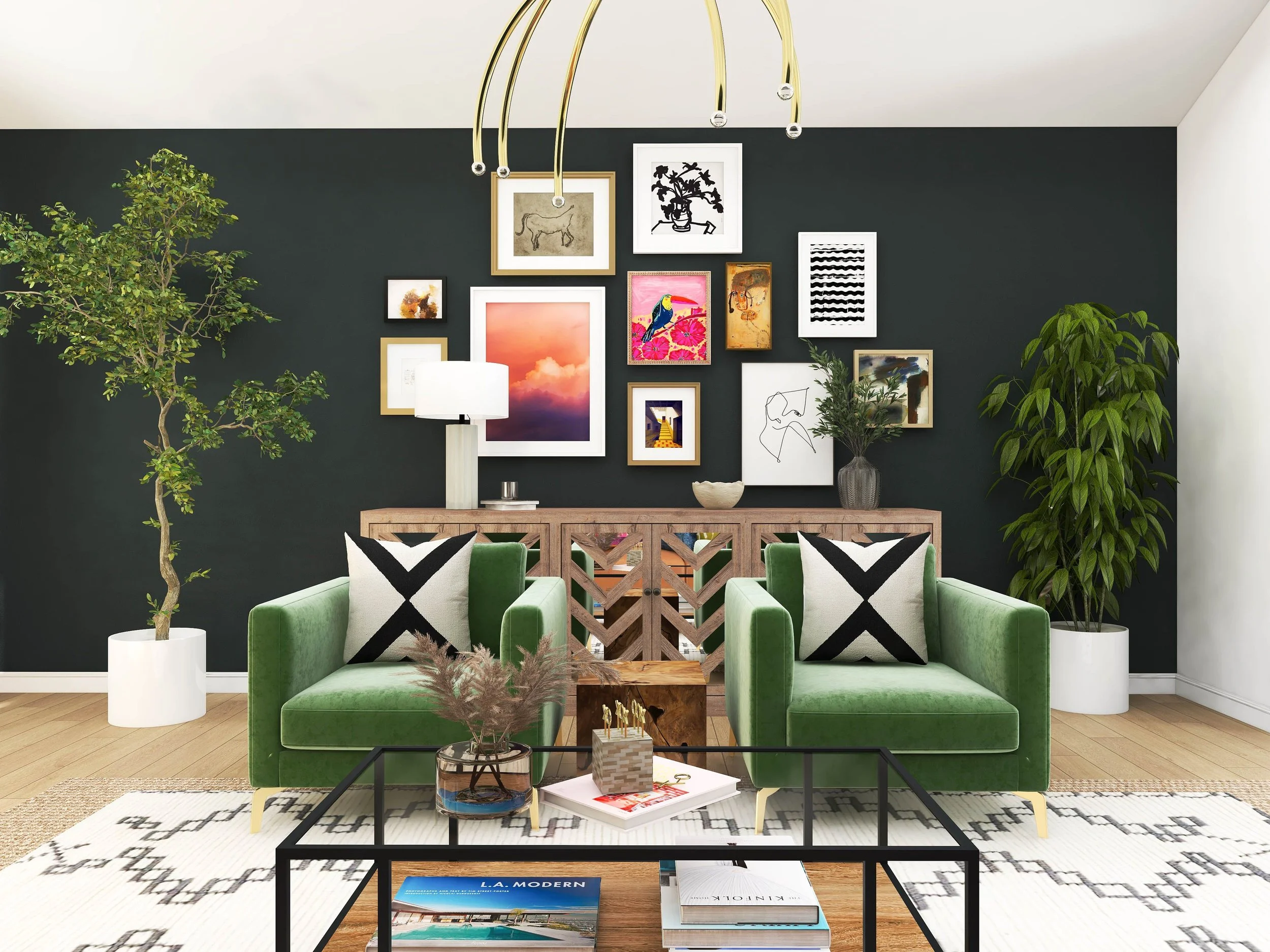
A modern eclectic living room with a colorful gallery wall, green accent chairs, and a natural-wood credenza, designed by virtual interior designer Joshua Jones of JJones Design Co.
Hi Nicole,
Thank you for writing in. Starting a gallery wall without owning any art may feel overwhelming, but it also gives you the freedom to build a collection that genuinely reflects your interests rather than designing around pieces you do not love.
The goal should not be to fill the wall as quickly as possible. A memorable gallery wall often develops over time as you discover artwork, photographs, and objects that have personal meaning.
Determine the Gallery Wall’s Boundaries
Before buying art, decide how much of the wall you want the arrangement to occupy. If the gallery wall will hang above a sofa, console, or credenza, the furniture should visually anchor the collection.
As a general guideline, the overall arrangement can span approximately two-thirds to three-quarters of the furniture’s width. It should feel substantial enough to relate to the furniture without extending awkwardly beyond it.
Use painter’s tape to outline the proposed gallery wall on the wall itself. This will give you a defined area to work within and help you understand how many pieces the space can accommodate.
If there is no furniture beneath the gallery wall, consider nearby doors, windows, switches, vents, and walkways. The arrangement should relate to the room’s architecture rather than appearing to float randomly on an empty wall.
Choose a Gallery-Wall Style
Gallery walls do not all follow the same layout. Decide whether you prefer a structured or organic arrangement before selecting the art.
A grid uses frames of the same size with consistent spacing. This creates a clean, orderly appearance and works particularly well for a series of photographs, botanical prints, or related artwork.
A linear arrangement follows a shared horizontal or vertical line while allowing the frame sizes to vary. It feels organized without being as formal as a grid.
An organic or salon-style gallery wall combines different sizes, orientations, and frame styles. This approach feels more collected and personal, but it still requires careful attention to balance and spacing.
Because you are beginning without any artwork, choose the layout that best reflects your personal style. A grid may be easier to plan all at once, while an organic gallery wall can grow gradually as you find new pieces.
Begin With an Anchor Piece
Rather than purchasing several small pieces immediately, begin with one larger work of art that you truly love. This anchor piece can establish the gallery wall’s color palette, mood, and overall scale.
The anchor does not need to hang in the exact center. Placing it slightly off-center can make an organic arrangement feel more natural. You can then add smaller pieces around it while maintaining visual balance.
If you cannot find one large piece, begin with a pair or small group that has enough presence to establish the arrangement. Avoid collecting only tiny frames because the completed wall may feel fragmented and visually weak.
Select Art That Feels Personal
Your gallery wall can include more than traditional paintings and prints. Consider combining:
Original artwork
Limited-edition or open-edition prints
Photography
Drawings and sketches
Vintage artwork
Family photographs
Textile art
Small mirrors
Framed maps, postcards, or meaningful documents
Sculptural or dimensional wall objects
The pieces do not need to share the same subject or medium. An abstract painting can hang beside a landscape photograph, a vintage drawing, and a textile piece if the overall arrangement has enough visual connection.
Look for art that reminds you of a place, person, experience, or interest. A gallery wall should reveal something about the person who lives in the home rather than looking like a coordinated set purchased in one afternoon.
You can certainly create a themed gallery wall if that feels more authentic to you. Black-and-white photography, botanical prints, travel art, or work by local artists can create a strong collection. The theme should come from your interests rather than a trend you feel obligated to follow.
Create Cohesion Without Making Everything Match
A successful gallery wall does not require matching artwork or identical frames. However, repeating a few elements will help the collection feel connected.
You might repeat two or three frame finishes, such as black, walnut, and aged brass. You could also use similar mat colors or select artwork that shares a few recurring colors.
If the art is highly varied, simpler frames can provide visual consistency. If the artwork has a restrained palette, mixing carved, modern, vintage, and metal frames can add character.
Avoid using too many unrelated frame finishes in a small arrangement. A larger gallery wall can support more variety, while a smaller collection usually benefits from tighter editing.
Mats can also create cohesion. Wide ivory or white mats give artwork breathing room and can make pieces of different sizes feel more substantial. A colored or fabric mat may be used occasionally as an accent, but it should relate to the rest of the collection.
Mix Artwork Sizes Carefully
Gallery walls are more interesting when they include a range of sizes, but the differences should feel intentional. Combine a few larger or medium pieces with smaller frames rather than using many pieces of nearly the same size.
Pay attention to visual weight as well as physical dimensions. A small piece with a dark image and heavy frame may feel as prominent as a larger piece with a light background and thin frame.
Distribute darker, brighter, and more detailed pieces throughout the arrangement. Placing all the visually heavy artwork on one side can make the entire composition feel unbalanced.
Maintain Consistent Spacing
Spacing is one of the most important elements of a gallery wall. For most arrangements, approximately two to three inches between frames creates a connected and intentional appearance.
You may use slightly larger spacing for oversized pieces or a looser collection, but avoid allowing the gaps to vary dramatically without a reason. Inconsistent spacing can make even beautiful artwork look disorganized.
Measure from the outer edge of each frame rather than the artwork or mat inside it. This will help you maintain consistent negative space throughout the arrangement.
Plan the Arrangement Before Hanging It
Lay the artwork on the floor within an area that matches the dimensions of the wall. Begin with the anchor piece, then move the remaining frames around it until the composition feels balanced.
Take a photograph of each arrangement you try. Comparing photographs can make it easier to identify which version feels the most cohesive.
Once you are satisfied, trace every frame onto kraft paper and cut out the shapes. Label each template so you know which artwork it represents, then attach the paper to the wall with painter’s tape.
Step back and view the templates from different parts of the room. This allows you to adjust the height, spacing, and overall shape before making holes in the wall.
Hang the Gallery Wall at the Right Height
Treat the gallery wall as one large composition rather than hanging each piece independently. The visual center of the complete arrangement should generally sit near eye level.
When the gallery wall hangs above a sofa or console, begin the lowest frames approximately six to eight inches above the furniture. The exact distance will depend on the frame sizes, ceiling height, and furniture proportions, but the art should feel connected to what is beneath it.
Do not automatically center every piece on the wall. Center the complete gallery-wall composition in relation to the furniture or architectural area it belongs to.
Use the Correct Hanging Hardware
Choose hanging hardware based on the weight of each piece and the type of wall. Larger or heavier frames may require wall anchors, two hooks, or attachment to a stud.
Using two hanging points can help keep frames level. Museum putty or removable frame bumpers at the lower corners can reduce shifting, particularly in active households.
If you rent your home, discuss acceptable hanging methods with your landlord. Removable adhesive strips may work for certain lightweight frames, but follow the manufacturer’s weight limits and surface instructions carefully. Do not use them for valuable, fragile, or heavy artwork.
Consider the Wall Color
A gallery wall does not require an accent wall. Artwork can look beautiful against a simple neutral color, and a quieter background may allow a varied collection to remain the focus.
If you want to use a deeper paint color or wallpaper, choose it before hanging the artwork. A subtle pattern, grasscloth, or saturated paint color can add depth, but a highly detailed wallpaper may compete with an already eclectic collection.
Consider how the wall treatment relates to the artwork, frames, furniture, and the rest of the room rather than adding it only to make the gallery wall feel more dramatic.
Allow the Collection to Grow Over Time
You do not need to complete the entire gallery wall immediately. Begin with a smaller arrangement and leave room for it to expand as you discover new artwork.
If you plan to grow the collection organically, start near the center and extend outward. Maintain similar spacing as you add pieces so the new artwork feels connected to the original arrangement.
A gallery wall assembled gradually often feels more personal than one purchased as a complete set. Give yourself permission to wait for pieces that genuinely deserve a place in your home.
If you need help choosing artwork, determining the right scale, or planning the arrangement, my virtual interior design service can help. I can create a personalized gallery-wall design based on your wall dimensions, furniture, existing décor, and personal style.
I hope this helps you begin collecting art with confidence and create a gallery wall that feels personal, balanced, and uniquely yours.
Warmly,
Joshua
Have interior design related questions? You can ask Joshua here.

