
Ask Joshua: Are Curved Sofas a Good Choice? Pros and Cons to Consider
Hi Joshua,
I have noticed curved sofas appearing in many interiors lately. I love their sculptural appearance, but I am wondering how practical they are compared with conventional straight sofas.
What are the advantages and disadvantages of owning a curved sofa, and how can I decide whether one will work in my living room?
Thank you,
Jane - Los Angeles, California
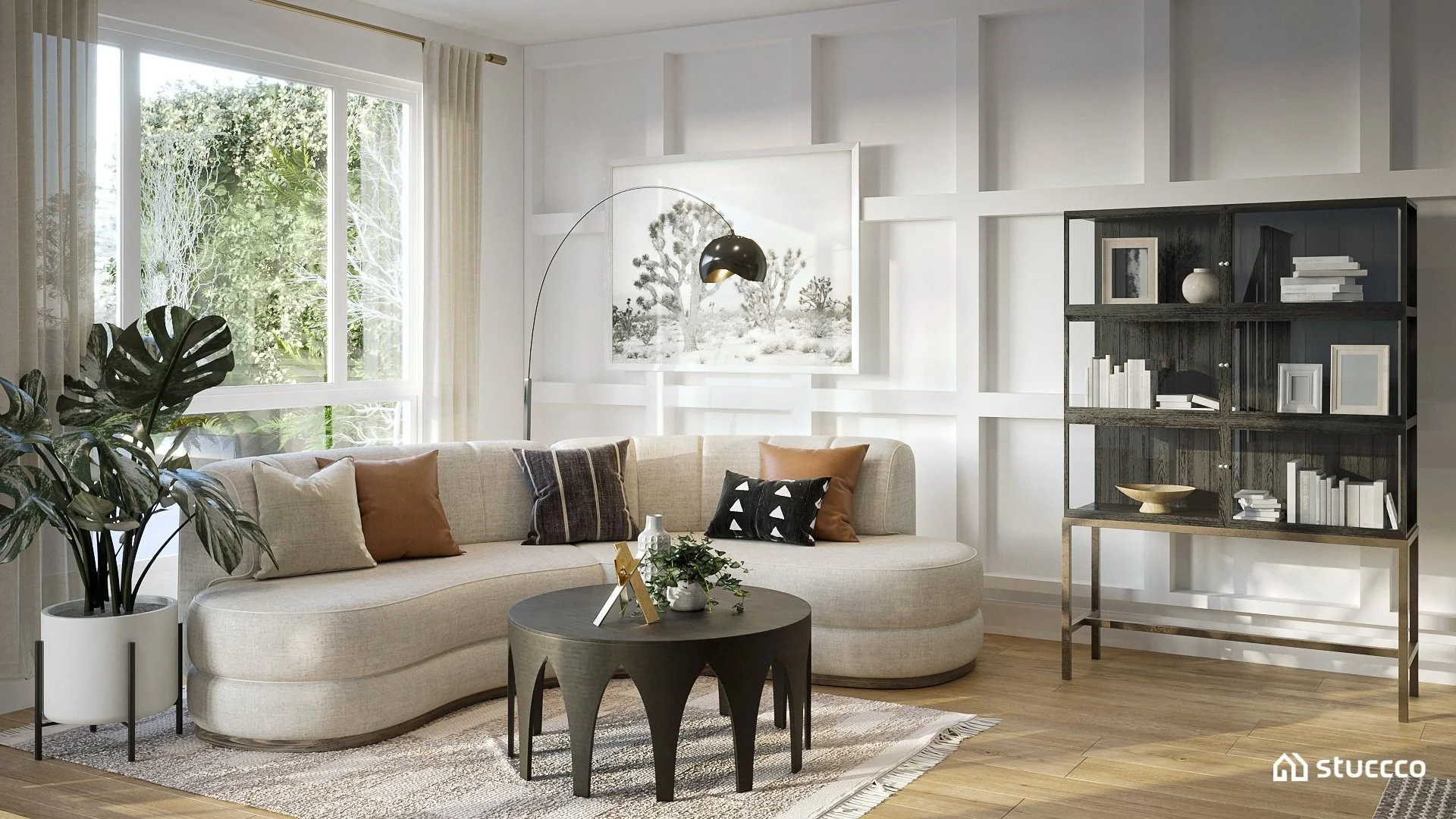
A California casual-style living room with a curved sofa, round coffee table, and layered neutral textures, designed by virtual interior designer Joshua Jones of JJones Design Co. 3D rendering by Stuccco.
Hi Jane,
Thank you for writing in with such a great question. Curved sofas are receiving plenty of attention, but they are not a completely new idea. Rounded seating has appeared throughout several periods of design history, and its popularity continues to return because curves can soften a room and encourage conversation.
However, a curved sofa should not be selected solely because it is currently fashionable. It is a substantial investment that affects the furniture layout, seating capacity, circulation, and the other pieces you will need around it.
What Are the Advantages of a Curved Sofa?
Curved Sofas Create a Strong Focal Point
A curved sofa has a sculptural presence that can make even a minimally furnished room feel intentionally designed. Its shape introduces movement and can provide a welcome contrast in rooms dominated by rectangular windows, walls, rugs, and cabinetry.
Because the sofa is already a statement, the surrounding furniture and décor can remain relatively restrained. This may appeal to you if you prefer fewer pieces with greater visual impact.
They Can Encourage Conversation
The gently rounded shape allows people seated at different points on the sofa to face one another more naturally. This can make a curved sofa especially effective in a formal living room, lounge, or other space primarily used for conversation and entertaining.
Two curved sofas facing each other can create an intimate seating area, while one curved sofa paired with swivel chairs can form a flexible conversation arrangement.
Curves Can Improve the Flow of a Room
Rounded edges may make circulation around the sofa feel more fluid, particularly when the piece floats away from the walls. A curved back can guide movement through an open floor plan more gracefully than the sharp corner of a large sectional.
However, this does not mean every curved sofa is a space-saving choice. Its actual footprint and the unused space behind it still need to be evaluated carefully.
They Can Help Define an Open Floor Plan
A curved sofa can create a soft visual boundary between a living area and an adjoining dining room, kitchen, or entry. When viewed from behind, its sculptural form can be more attractive than the long straight back of a conventional sofa.
This makes curved seating particularly effective when the sofa will float in the center of a room rather than sit against a wall.
What Are the Disadvantages of a Curved Sofa?
They Can Require More Floor Space
Although a curved sofa may look visually lighter than a blocky sectional, it does not necessarily occupy less space. When placed against a straight wall, the curved back can leave unusable gaps behind the sofa. It may also project farther into the room than expected.
A curved sofa typically works best when it has enough space around it to be appreciated from several angles. In a very narrow room, a straight sofa may use the available floor area more efficiently.
Seating Capacity Can Be Misleading
A curved sofa may appear large but provide fewer truly comfortable seats than a straight sofa of a similar overall width. The ends can narrow, and the curved seat may not give every person the same depth or back support.
Review the interior seating dimensions rather than judging capacity from the sofa’s total width. If possible, sit on different parts of the sofa before purchasing it.
It May Not Be Ideal for Watching Television
Curved sofas are naturally suited to conversation, but not every seat will face a television directly. People sitting toward the ends may need to turn their heads or bodies to see the screen comfortably.
If television viewing is the room’s primary activity, study the angle of each seat carefully. A shallow curved sofa with a low back may also be less comfortable for long periods of lounging than a deeper conventional sofa or sectional.
Some curved sofas include a chaise or modular components, which can improve comfort, but these versions may require considerably more room.
Coordinating Other Furniture Can Be More Difficult
A standard rectangular coffee table may feel awkward inside the curve of the sofa. Round, oval, organic, or softly shaped tables often relate more naturally to curved seating.
Leave approximately 14 to 18 inches between the sofa and coffee table so the surface remains accessible without restricting movement. Depending on the length of the sofa, two smaller tables may work better than one large table.
End tables can also be challenging because the sofa arms may angle away from the walls. Small round tables, C-shaped tables, or drink tables are often easier to position than large square end tables.
Rugs Require Careful Sizing
You do not need a curved rug simply because the sofa is curved. A large rectangular rug can anchor the seating arrangement and provide a stable foundation for the room.
The rug should be large enough for at least the front legs of the sofa and nearby chairs to rest on it. A rug that barely follows the interior curve of the sofa may look undersized and disconnected.
Delivery Can Be Complicated
A curved sofa may be more difficult to maneuver through narrow doors, hallways, elevators, and staircases because it cannot always be rotated as easily as a straight sofa.
Before ordering, confirm the sofa’s full dimensions and request a delivery diagram if one is available. Measure every doorway, hallway, turn, staircase, and elevator between the entrance and the room. A modular curved sofa may be easier to deliver because it arrives in separate sections.
Curved Sofas Offer Less Flexibility
A straight sofa can usually move between different walls or rooms more easily. A curved sofa may work beautifully in one specific layout but feel difficult to place after a move or furniture rearrangement.
Its specialized shape can also make slipcovers, reupholstery, and replacement cushions more complicated or expensive. If you expect to move soon or frequently change your layout, a conventional sofa may offer greater flexibility.
How to Determine Whether a Curved Sofa Will Fit
Do not rely only on the dimensions listed online. A curved sofa’s width and depth do not fully communicate the shape of its footprint.
Obtain a floor plan or product template from the retailer when possible. You can also mark the sofa’s approximate outline on the floor with painter’s tape. Use cardboard boxes or lightweight furniture to represent its volume and help you understand how far it will project into the room.
View the outline from every entrance and adjoining space. Make sure the sofa does not block an important sightline, fireplace, window, or natural walking path. Try to preserve approximately 30 to 36 inches for primary circulation routes around the seating area.
Also consider the view from behind. If the curved sofa will float in the room, its back will become an important part of the design. Look for attractive upholstery, clean seams, and a finished shape from every angle.
Is a Curved Sofa Right for Your Living Room?
A curved sofa may be a wonderful choice if you have enough room for it to float, want to create a conversation-focused seating area, and appreciate furniture with a sculptural presence. It can also help soften an angular room and define a living area within an open floor plan.
A straight sofa may be the better choice if the room is narrow, the sofa must sit against a wall, television viewing is the priority, or you need the greatest possible seating capacity and layout flexibility.
My recommendation is to evaluate the sofa based on your room and lifestyle rather than its popularity. A curved sofa that supports the way you live can remain beautiful long after the current trend cycle changes. One purchased only because it looks appealing in photographs may become frustrating once you begin arranging the rest of the room around it.
If you need help determining whether a curved sofa will fit your room and selecting the right supporting furniture, my virtual interior design service can help. I can create a personalized furniture layout based on your measurements, walkways, focal points, and daily activities.
I hope this helps you decide whether a curved sofa is the right combination of beauty, comfort, and function for your home.
Warmly,
Joshua
Have interior design related questions? You can ask Joshua here.