
Ask Joshua: Epoxy vs. Cement Grout—Which Is Better for Bathroom Tiles?
Hi Joshua,
Would you use GoPoxy or normal grout on both floor and wall tiles in the bathroom? And epoxy for mitre edges?
—H in United Kingdom
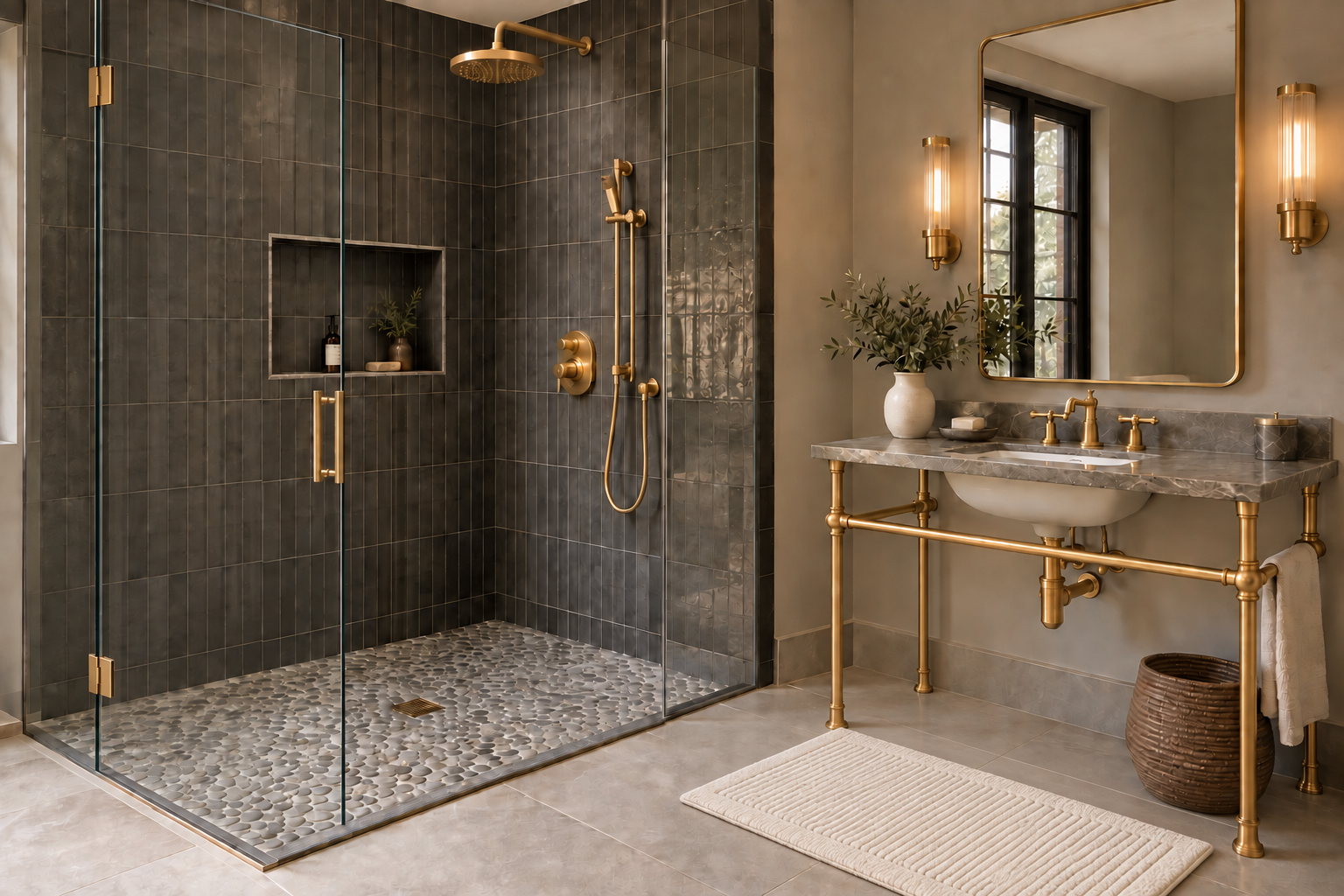
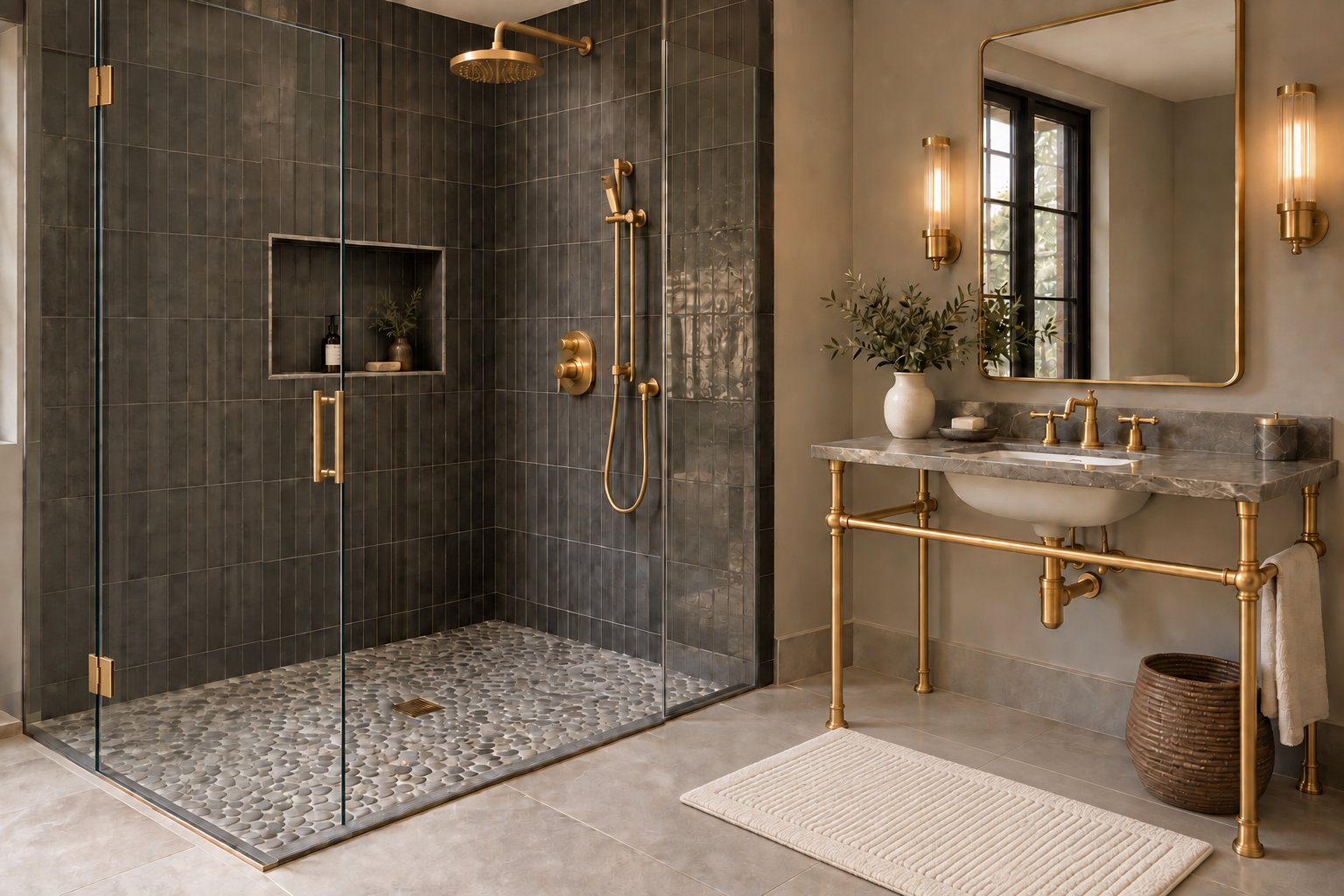
This bathroom concept was styled by virtual interior designer Joshua Jones of JJones Design Co. for this blog post, featuring charcoal vertical tiles with gray grout, a gray river rock shower floor, and brass details. Image created using AI.
Hi H,
Grout might seem like a small detail, but it affects both the appearance of your bathroom and how much maintenance it will need. I would consider epoxy grout for shower floors and walls when stain resistance and easier maintenance are priorities. A quality cement-based grout can also be a suitable choice for bathroom tiles, especially outside the shower. The best option depends on your tile, budget, and the product your installer recommends for the installation.
For your mitre edges—called mitered edges here in the United States—I would treat that as a separate decision. Epoxy grout and the epoxy resin used to finish or bond certain tile edges serve different purposes.
What Is the Difference Between Epoxy and Cement Grout?
Cement-based grout is the traditional option used between tiles. Epoxy grout uses a resin and hardener system and generally offers greater resistance to staining. Epoxy grout does not normally need sealing, although the tile itself may still require it.
Here is how I would compare them when planning a bathroom:
Cost: Epoxy grout generally costs more for materials and installation. Cement-based grout is usually more affordable.
Stain resistance: Epoxy grout generally offers greater stain resistance. Cement-based grout’s performance depends on its formulation and maintenance.
Sealing: Epoxy grout generally does not require sealing. For cement-based grout, check the manufacturer’s instructions to determine whether sealing is recommended.
Installation: Epoxy grout requires careful application and cleanup. Cement-based grout is often more familiar to installers.
Appearance: For either option, check a cured sample alongside your tile to see the actual color and texture before making your decision.
Should You Use Epoxy Grout on Bathroom Floors and Walls?
You can use an appropriate epoxy grout on both floor and wall tiles, but I would not choose it simply because a surface is in a bathroom. I would consider how much water, dirt, and daily use that surface receives.
For a frequently used shower, epoxy grout is worth discussing with your installer, particularly if you want light-colored grout and are concerned about staining. Its stain resistance and lack of routine grout sealing can make it appealing. It still needs regular cleaning, though.
For walls outside the shower and bathroom floors that receive less direct water exposure, a suitable cement-based grout may meet your needs at a lower cost.
You also do not have to use the same grout formulation throughout the bathroom. If your installer recommends epoxy in the shower and cement grout elsewhere, I would ask to see cured samples of both. Similar color names do not necessarily produce an identical finished appearance.
Would I Choose GoPoxy?
GoPoxy offers an epoxy tile grout, so it is a product you could discuss with your installer. However, I would want to confirm the exact product, your tile material, and the installation requirements before recommending it for your bathroom.
My advice would be to ask your installer:
Is this product suitable for my particular floor and wall tiles?
Does it suit the width and depth of the tile joints?
Have you used it successfully on a similar installation?
Can we make a sample to check the color, finish, and cleanup?
A sample is especially helpful if your tile has a textured surface or a delicate finish. Manufacturer guidance may call for pre-sealing or a grout release before applying epoxy grout to certain tiles.
Should You Use Epoxy for Mitre Edges?
A mitered tile edge is created by cutting adjoining tile edges at an angle so they meet neatly at an outside corner. This can give a bathroom a tailored finish without a visible trim.
I would ask your installer to specify the appropriate edge-finishing material rather than assume the grout used between the tiles should also finish the miter. Depending on the tile and corner detail, they may recommend a compatible, color-matched epoxy resin or another approved material. Dedicated epoxy adhesives used for fabrication and lamination are a different product category from tile grout.
From a design standpoint, I would want to see a sample corner. The color match, joint size, and workmanship all influence whether that edge looks clean and intentional.
Does Epoxy Grout Replace Silicone or Waterproofing?
No. Epoxy grout does not replace the waterproofing system behind or beneath your bathroom tiles. Even highly water-resistant grout does not make the entire tile installation waterproof.
It also does not replace flexible sealant at joints designed to accommodate movement. GoPoxy specifically states that its grout is not intended to replace silicone or movement joints where movement is expected. These details should be addressed separately by your installer.
My Recommendation for Your Bathroom
I would start by discussing epoxy grout for the shower floor and walls, then compare the additional cost with a suitable cement-based option for the remaining tiled surfaces. For the mitered edges, I would ask your installer for a separate recommendation and a sample of the proposed finish.
Whichever grout you choose, take time to check its color alongside your tile. A close match creates a quieter, more continuous surface, while contrast emphasizes the tile pattern. That small decision can have a noticeable effect on the finished bathroom.
Warmly,
Joshua
Have interior design related questions? You can ask Joshua here.