
How to Decorate Your Home for the Holidays: A Complete Interior Designer’s Guide
Decorating your home for the holidays should be an enjoyable experience, but it can quickly become overwhelming. You bring out boxes filled with decorations, start placing things around the house, and suddenly wonder why everything feels disconnected—or why the room looked better before you started.
The problem usually isn’t the decorations themselves. It’s that we often decorate one item or surface at a time without first considering how the entire home should look and function.
I approach holiday decorating much like I approach any interior design project. I look at the existing style of the home, establish a color palette, identify the most important focal points, and then decide where decorations will have the greatest impact.
You don’t need to decorate every room or follow a specific holiday tradition to create a festive home. Whether you celebrate Christmas, Hanukkah, another holiday, or simply enjoy making your home feel special during the winter season, the same basic design principles apply.
This guide will help you decorate your home for the holidays in a way that feels welcoming, personal, and connected to the home you already love.
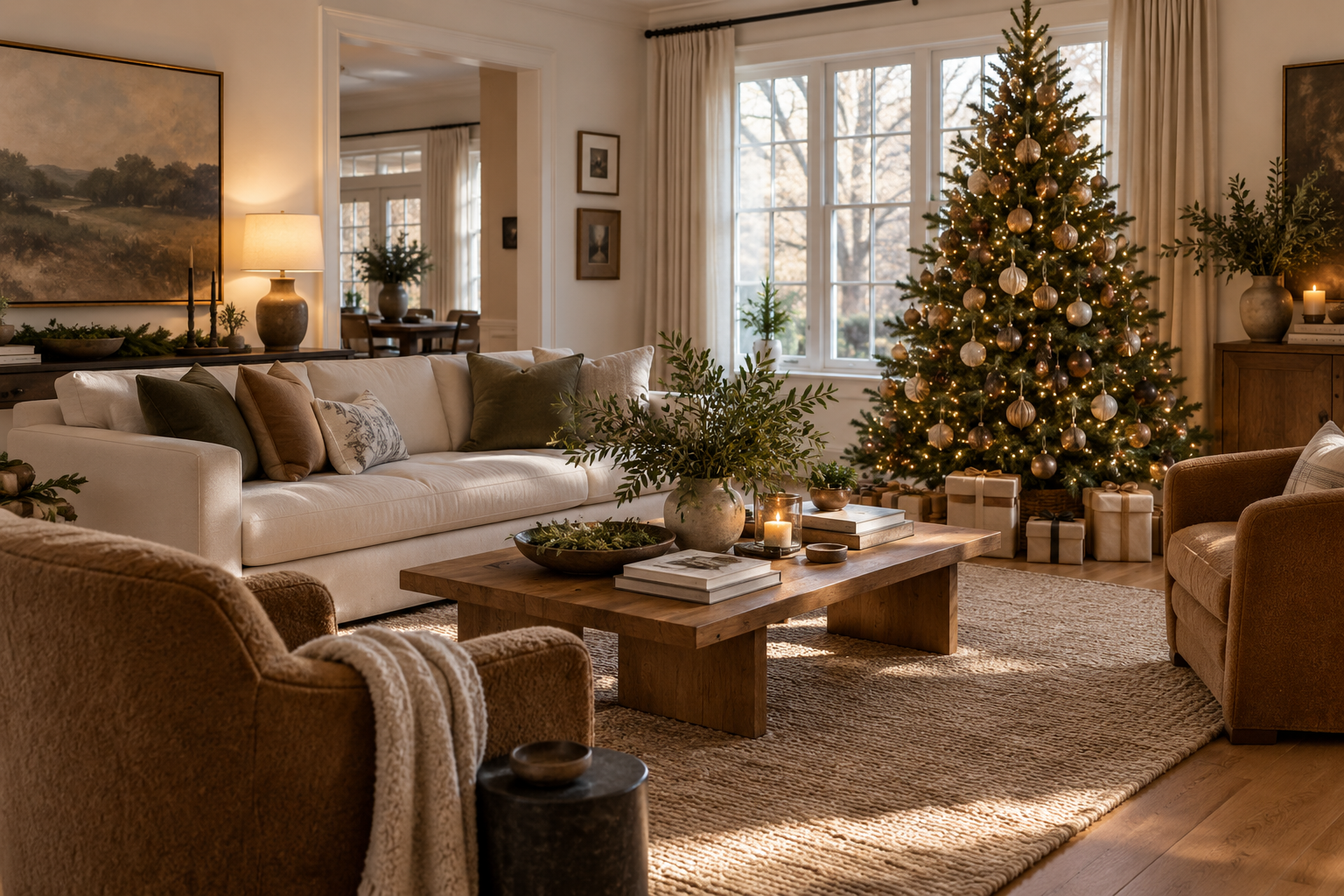
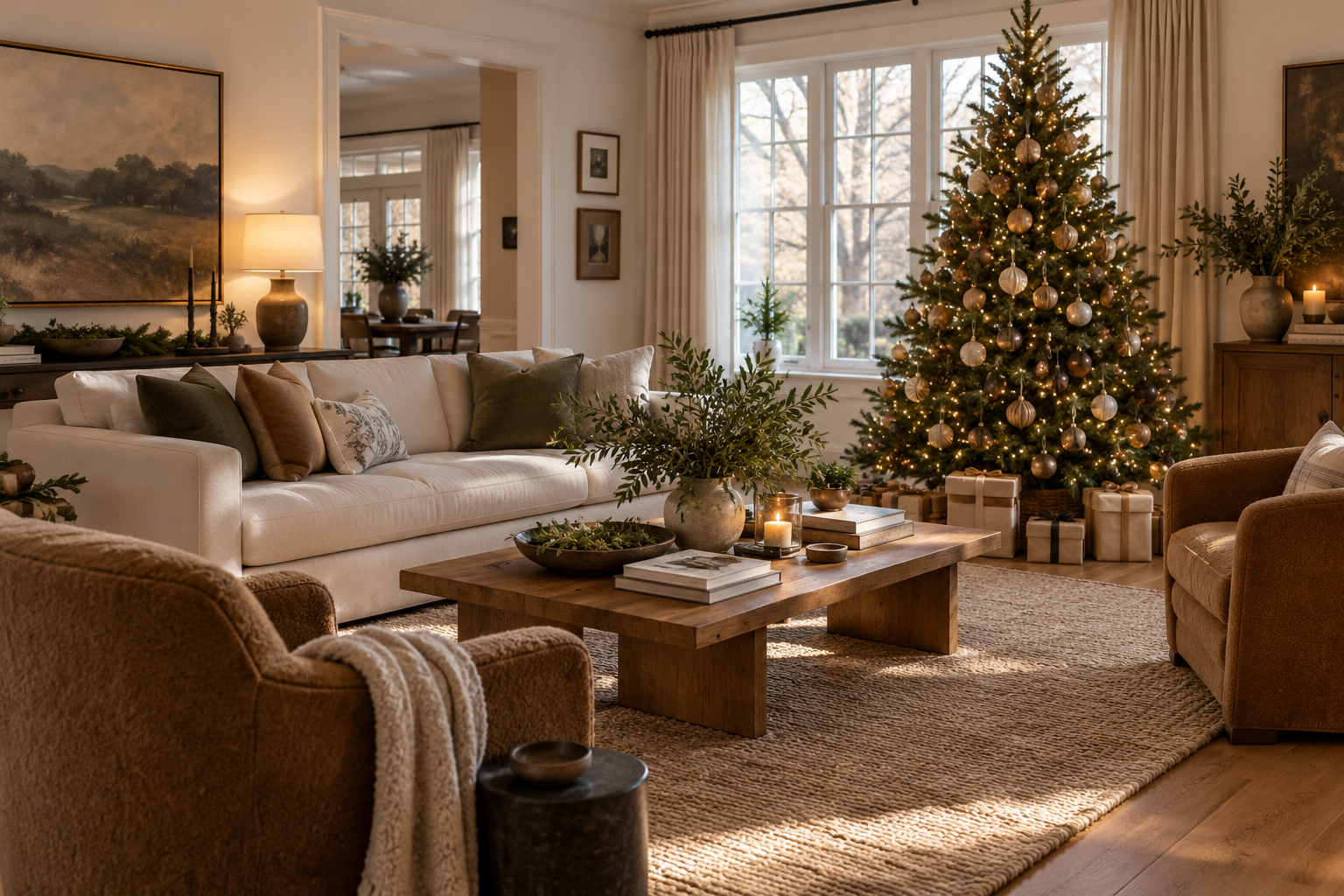
A warm modern-organic living room where holiday decorations complement the home’s existing furniture, artwork, and color palette. AI-generated image styled by virtual interior designer Joshua Jones of JJones Design Co.
1. Begin With the Home You Already Have
Before unpacking your holiday decorations, take a look around your home.
What colors, materials, and design styles are already present? Do you have a warm and traditional living room, a colorful eclectic home, or a clean modern space with very little visual clutter?
Your holiday decorations do not need to match your interior perfectly, but they should feel like they belong there. A room with warm wood furniture and earthy colors might look beautiful with natural greenery, deep red accents, brass bells, and handmade ornaments. A modern home might feel more comfortable with simple branches, sculptural decorations, and a limited color palette.
This does not mean you have to replace decorations that hold sentimental value. It simply means using the character of your home as the foundation and then layering the holidays into it.
I also recommend taking a few photographs of your rooms before you begin. A photograph often reveals areas that already feel full, empty corners that could support a holiday display, or furniture that may need to move temporarily.
You are not starting with a blank room. You are adding another layer to an existing home, and that distinction makes the decorating process much easier.
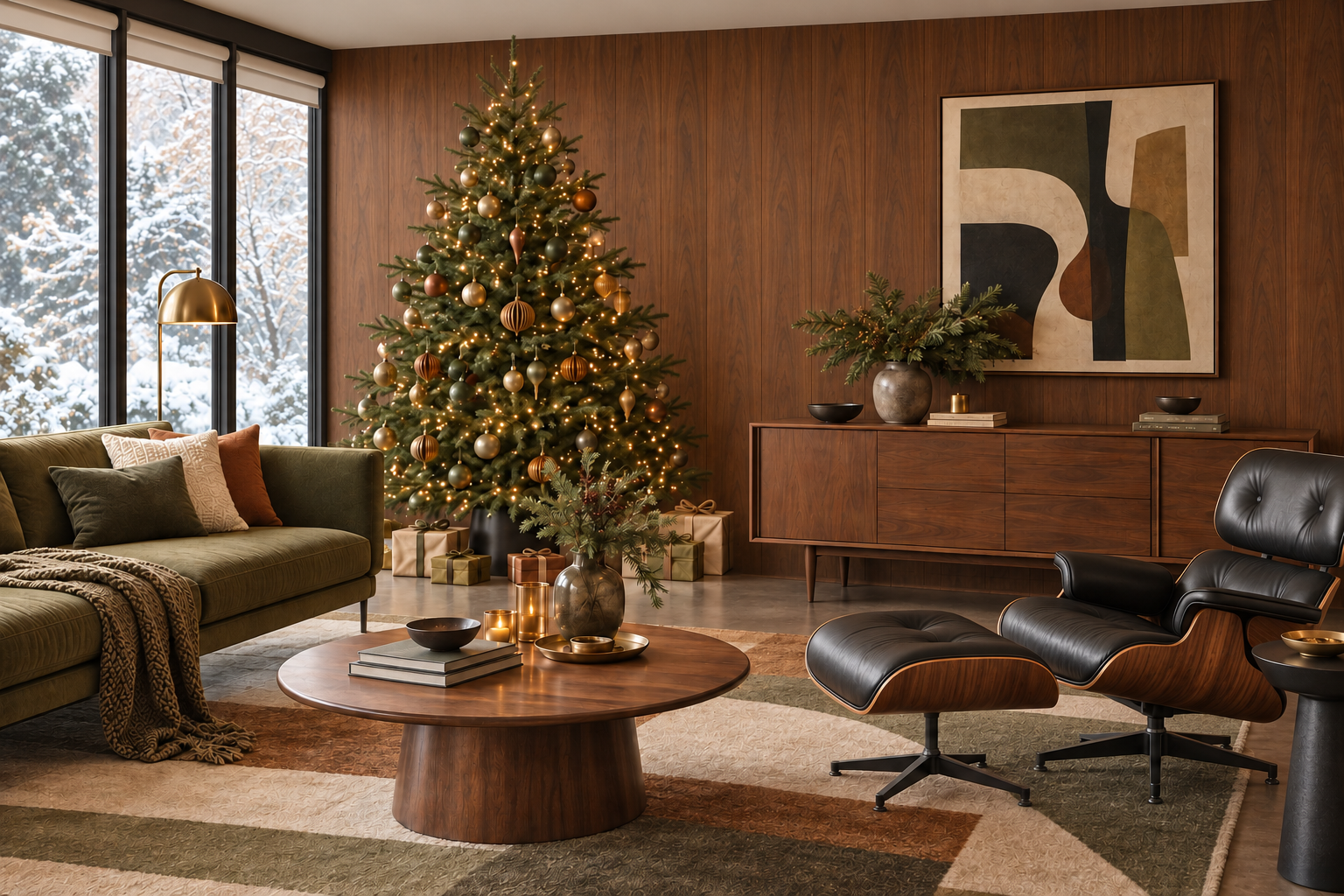
Mid-century modern holiday decor featuring walnut paneling, an olive green sofa, an Eames lounge chair, and a Christmas tree styled to complement the room. AI-generated image styled by virtual interior designer Joshua Jones of JJones Design Co.
2. Choose a Holiday Decorating Style
One of the easiest ways to prevent holiday decorations from feeling disconnected is to choose an overall style before you begin.
Your holiday style could be traditional, Scandinavian, modern organic, mid-century modern, minimal, glam, or a mixture that reflects your home and personality. You do not need to follow the style rigidly. It is simply a reference point that helps you make decisions.
For example, if you want a natural and relaxed look, you might focus on greenery, wood ornaments, warm white lights, linen ribbon, and softer colors. If you prefer something glamorous, glass ornaments, metallic finishes, velvet ribbon, and reflective surfaces may feel more appropriate.
Choosing a direction also makes it easier to decide what not to use. You may own many beautiful decorations that do not all work together in the same room. Some can be used elsewhere, rotated from year to year, or left in storage without making your home feel any less festive.
If you are uncertain which direction fits your home, my guide to Christmas decorating styles explains the characteristics of several popular looks and how they work with different interiors.
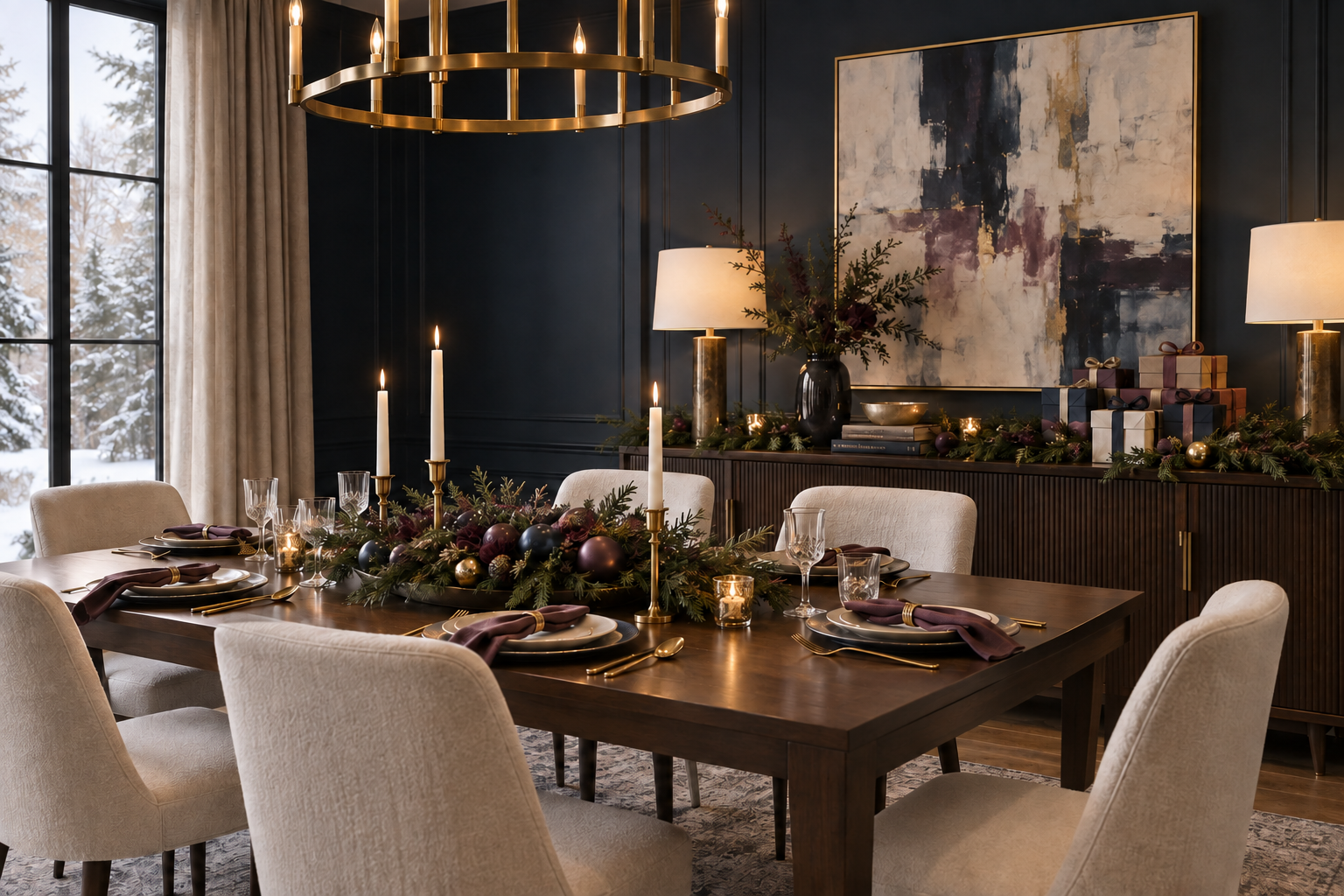
An elegant holiday dining room with navy, plum, champagne gold, ivory, and natural greenery repeated throughout the space. AI-generated image styled by virtual interior designer Joshua Jones of JJones Design Co.
3. Create a Holiday Color Palette
Red, green, gold, and silver may be closely associated with the holidays, but they are not your only choices.
I recommend beginning with the colors already used in your home and selecting two or three holiday colors that complement them. You can then introduce those colors through ribbon, ornaments, textiles, candles, greenery, or small decorative pieces.
A neutral living room might work well with forest green, bronze, and cream. A room with navy furniture could be paired with silver, icy blue, and white. If your home already contains strong colors, you might repeat one of them in the holiday decorations rather than introducing several new shades.
The finishes matter too. Using matte, glossy, metallic, transparent, and textured decorations within the same color family creates depth without making the palette feel busy.
You do not have to use the exact same colors in every room. Instead, carry at least one repeating color or material from one space to the next. A brass accent used in the entryway might reappear on the tree and again on the dining table. That small amount of repetition helps the house feel connected.
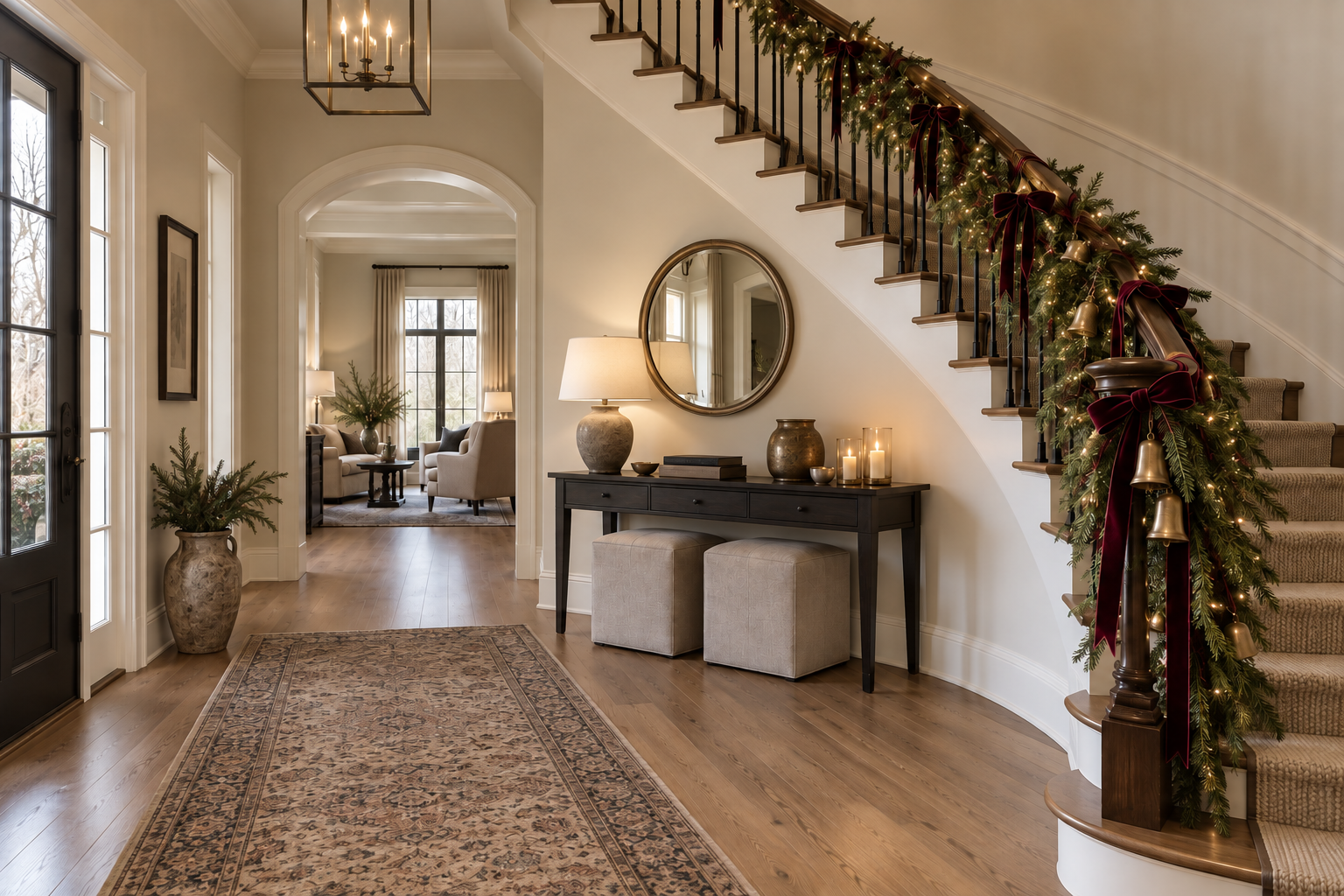
A holiday entryway where a decorated staircase and console create one strong focal point without overwhelming the surrounding rooms. AI-generated image styled by virtual interior designer Joshua Jones of JJones Design Co.
4. Decide Where Your Decorations Will Have the Most Impact
Not every room—or every surface—needs holiday decorations.
Start by identifying the places people notice first and the areas where you spend the most time. For many homes, that includes the front door, entryway, living room, dining area, and kitchen. If you live in a smaller home or apartment, one main display may be enough.
I like to establish one primary focal point and then support it with a few smaller moments throughout the home. The focal point might be a decorated tree, a fireplace mantel, a dining-room sideboard, a staircase, or a large window. It should be the first place your eye naturally lands when you enter the room.
The remaining decorations should support that feature instead of competing with it. If the tree is elaborate, the coffee table and mantel can be quieter. If you do not have a tree, a beautiful arrangement of greenery, lights, and collected objects can take on a larger role.
This approach creates visual hierarchy. It also saves time because you are concentrating your effort where it will be noticed rather than placing something on every table, shelf, and countertop.
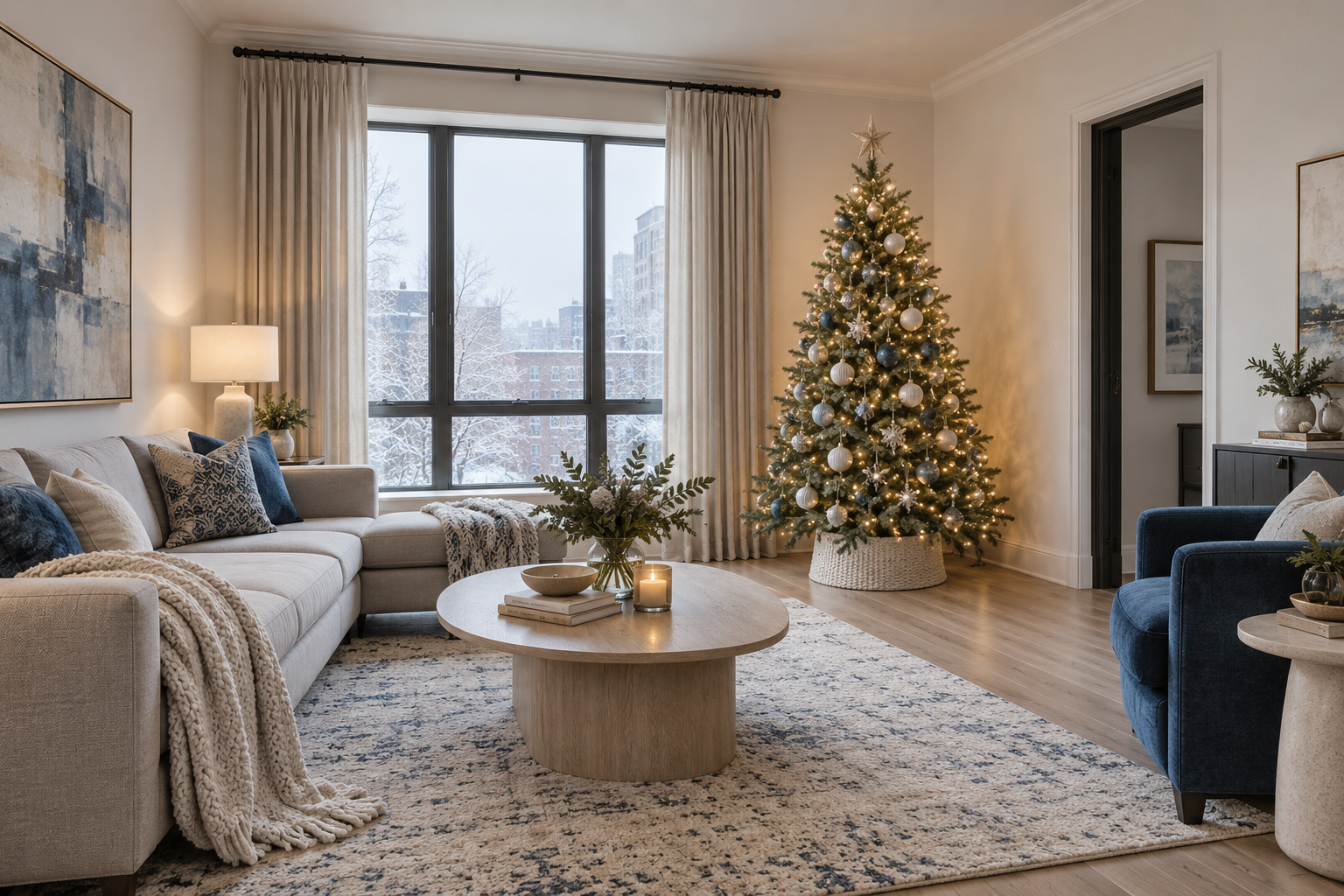
A properly scaled Christmas tree placed in an open corner with comfortable ceiling clearance and an unobstructed walkway around the seating area. AI-generated image styled by virtual interior designer Joshua Jones of JJones Design Co.
5. Choose the Right Christmas Tree for Your Room
For households that celebrate Christmas, the tree is often the largest holiday decoration in the home. Its size and placement will affect the entire room, so measure before you buy one or bring it out of storage.
Look at more than the ceiling height. Consider the width of the tree, the furniture arrangement, nearby doors, heating vents, and the walkways people use every day. A tall tree that forces everyone to squeeze around the sofa is not the right tree for that room.
You also need to allow room for the stand, tree topper, and enough open space above the tree so it does not feel pressed against the ceiling. My Christmas tree height guide explains how to select a proportionate height for different rooms and ceiling conditions.
If you are buying an artificial tree, you will also need to choose between built-in lights and adding your own. Pre-lit trees are convenient, but unlit trees allow more flexibility and can be easier to maintain over the long term. I compare both options in my guide to pre-lit versus unlit Christmas trees.
A flocked tree can create a beautiful snowy appearance, although it comes with maintenance, storage, and styling considerations. Before committing to one, review the pros and cons of flocked Christmas trees.
If you prefer a real tree, placement and daily care will determine how well it holds up. Keep it away from direct heat and make sure it receives enough water. My guide to keeping a real Christmas tree, wreaths, and garlands fresh longer provides more detailed care instructions.
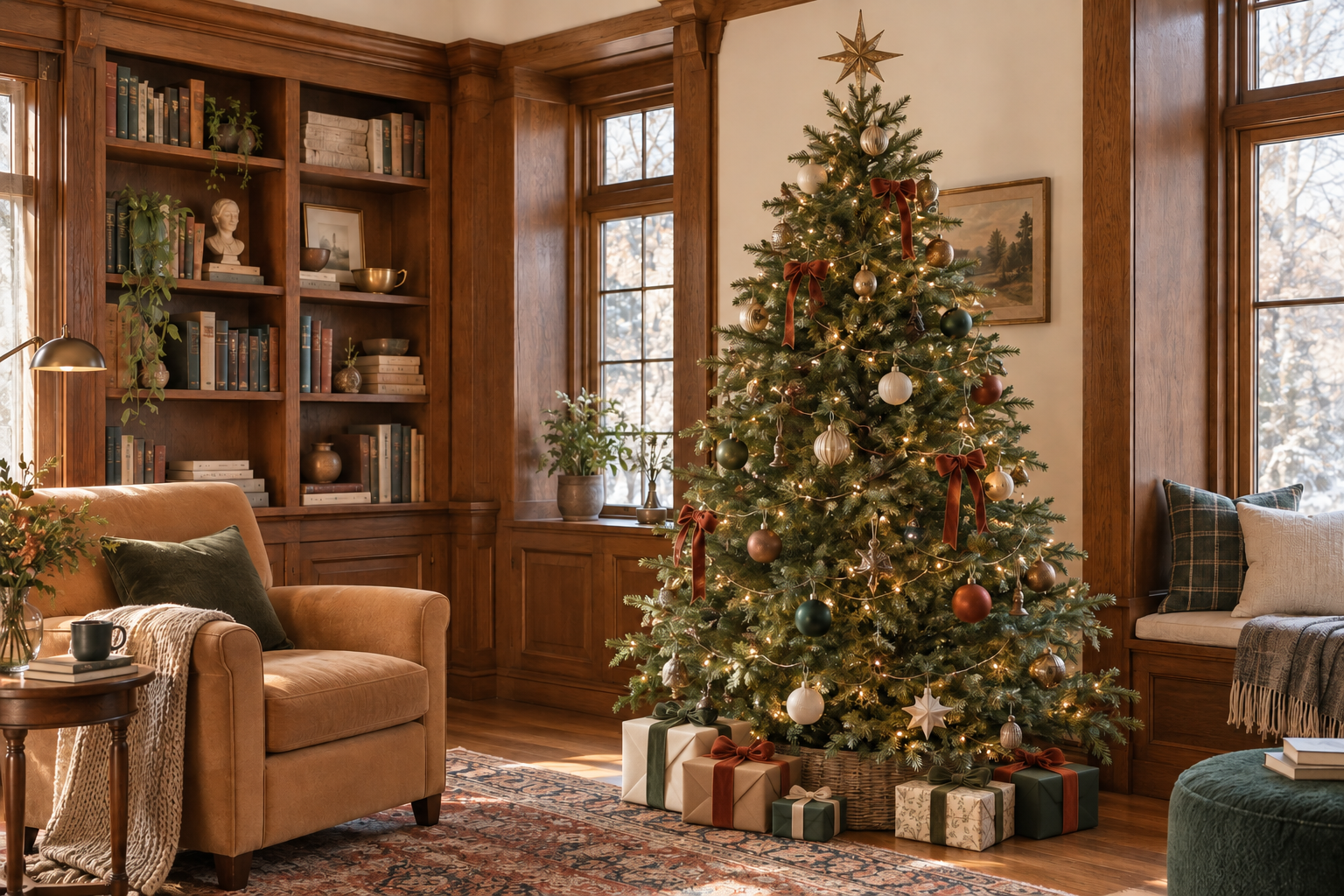
A thoughtfully decorated Christmas tree with warm lights, restrained ribbon, and well-spaced ornaments that allow the natural branches to remain visible. AI-generated image styled by virtual interior designer Joshua Jones of JJones Design Co.
6. Decorate the Tree Without Overcrowding It
Before putting ornaments on the tree, step back and look at its overall shape. Fluff the branches of an artificial tree, check a real tree for visible gaps, and make sure the tree is standing straight.
If you are adding lights, distribute them throughout the tree rather than placing them only on the ends of the branches. Lights positioned at different depths create a softer glow and give the tree more dimension.
Garland or ribbon usually comes next, followed by larger ornaments and then smaller pieces. Larger decorations help establish balance, while smaller ornaments can fill gaps and add detail. Place some ornaments slightly inside the branches instead of hanging everything along the outer edge.
Sentimental ornaments do not need to follow the color palette perfectly. They tell the story of your household and keep the tree from looking like a store display. If one ornament strongly clashes with the rest, place it where it can be appreciated without becoming the first thing everyone sees.
You also do not have to use every ornament you own. A tree needs enough open space for individual pieces to remain visible. If you still have a box left after the tree feels complete, there are many stylish ways to use extra Christmas ornaments beyond the tree.
Finally, give some thought to the base. Tree skirts create a softer, more traditional appearance, while baskets and collars offer a cleaner, more structured finish. A collar can also help protect the area around the stand from curious pets, small children, and vacuum cleaners. My Ask Joshua post explains what a Christmas tree collar is and why you might use one.
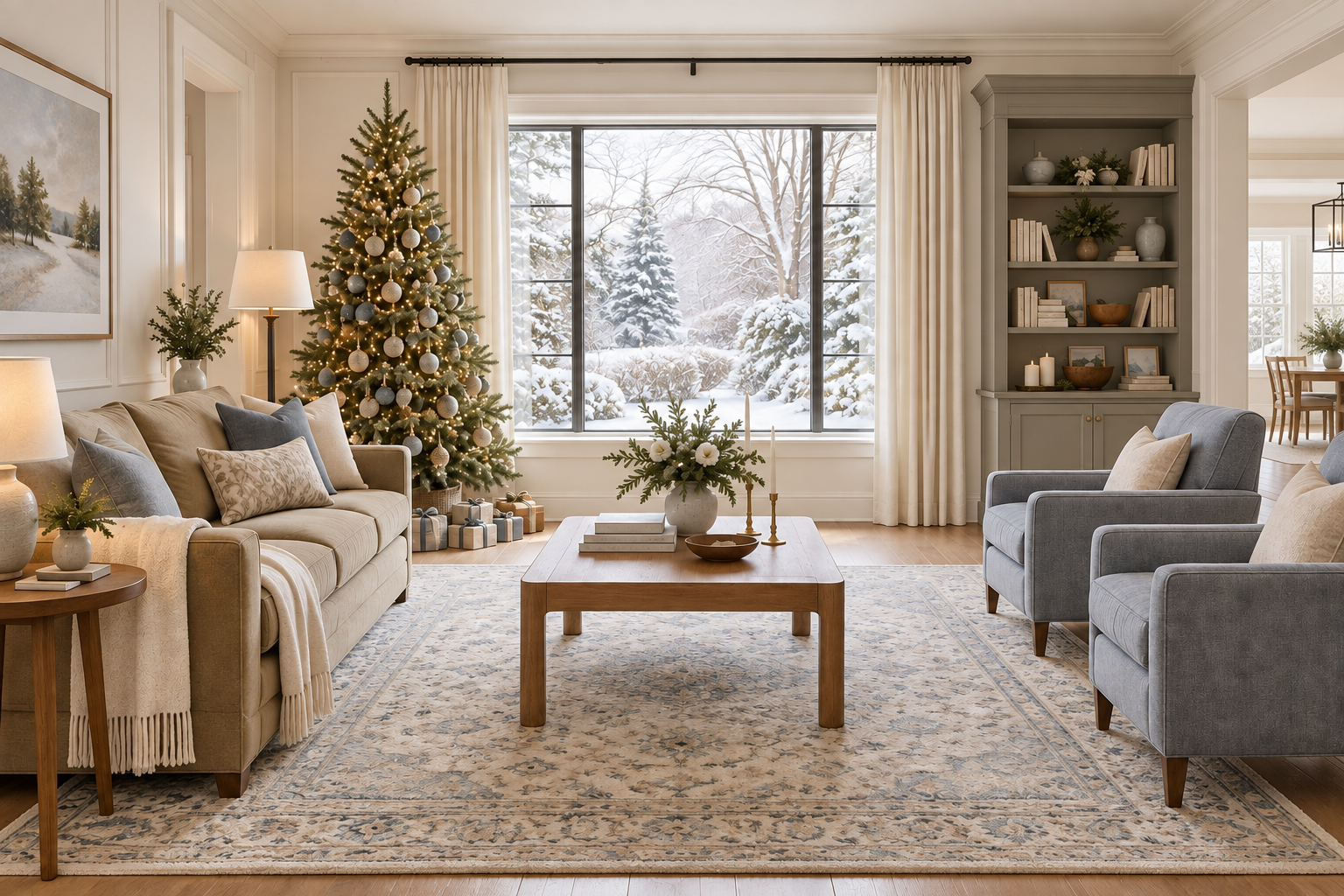
A bright holiday living room where a picture window, decorated tree, and styled bookcase create a welcoming focal point without a fireplace. AI-generated image styled by virtual interior designer Joshua Jones of JJones Design Co.
7. Style the Living Room With or Without a Fireplace
The living room is usually where holiday decorating has the greatest effect because it is where people gather, relax, and entertain.
If you have a fireplace, the mantel can support the tree without trying to match it exactly. Repeat a few related elements—perhaps the same greenery, ribbon, or metallic finish—but change the scale and arrangement. If the tree is already full and colorful, a simple garland across the mantel may be all the room needs.
Be careful with height and depth. Tall decorations can block artwork, mirrors, or televisions, while an oversized garland can make a shallow mantel look heavy. Candles, string lights, and greenery should also be kept safely away from heat and open flames.
Many homes do not have a fireplace, and that does not make them any less suited to holiday decorating. A media console, bookcase, sideboard, large window, or piece of artwork can become the room’s focal point. You could also group lanterns, candles, or a small tree around a console to create warmth without pretending the space has a mantel.
My guide to making a living room cozy without a fireplace offers several ways to create that sense of warmth throughout the year.
Whichever focal point you choose, keep the room functional. Do not move seating so far apart that guests cannot have a conversation, cover every table needed for drinks, or allow decorations to block the television. The living room still needs to work after it has been decorated.
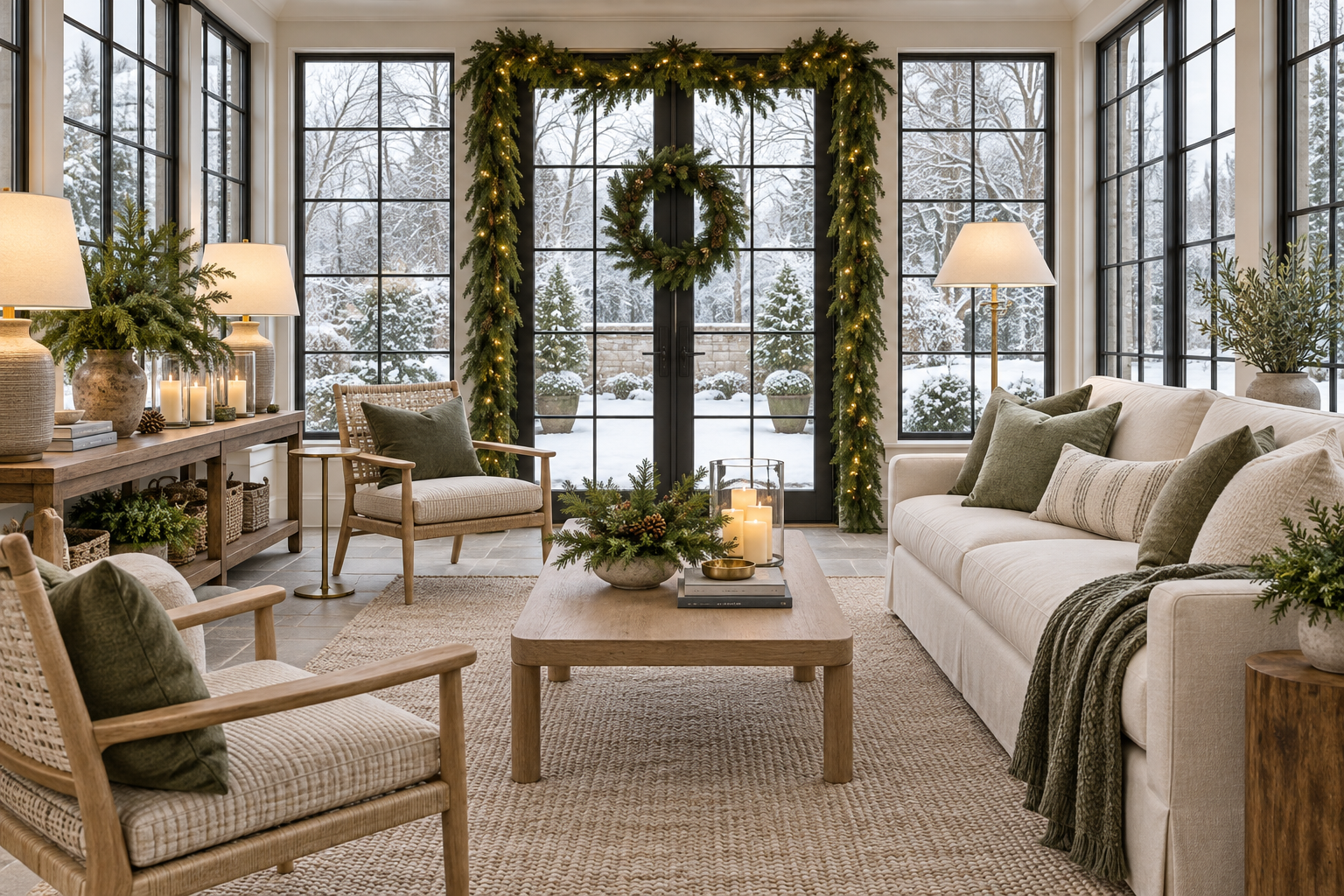
A light-filled sunroom warmed with evergreen garland, a natural wreath, layered lamps, warm micro-lights, and flameless candles. AI-generated image styled by virtual interior designer Joshua Jones of JJones Design Co.
8. Use Greenery and Lighting to Create Warmth
Greenery is one of the easiest ways to carry holiday decor from one room to another. It works across many decorating styles and can be used on mantels, stair railings, consoles, dining tables, doorways, and kitchen islands.
You can use real greenery, realistic artificial greenery, or a combination of both. Mixing them works best when the colors and textures are similar. Fresh clippings can also be added to an artificial garland to give it more movement and fragrance without requiring the entire display to be replaced.
Avoid placing greenery everywhere simply because you have it. A garland should frame or emphasize something—a doorway, railing, mantel, mirror, or table—not hang across every available edge.
Lighting brings those displays to life, especially during Seattle’s dark winter evenings. Layer your holiday lights with the room’s everyday lighting instead of relying on the tree alone. Table lamps, floor lamps, sconces, and flameless candles help distribute light throughout the room and prevent dark corners.
Warm white holiday lights generally feel more comfortable when the surrounding lamps are also warm. Mixing very blue string lights with yellow household bulbs can make the room look disconnected. If you are unsure which bulb temperature works best in your home, my warm-versus-cool lighting guide explains how color temperature changes the appearance and mood of a room.
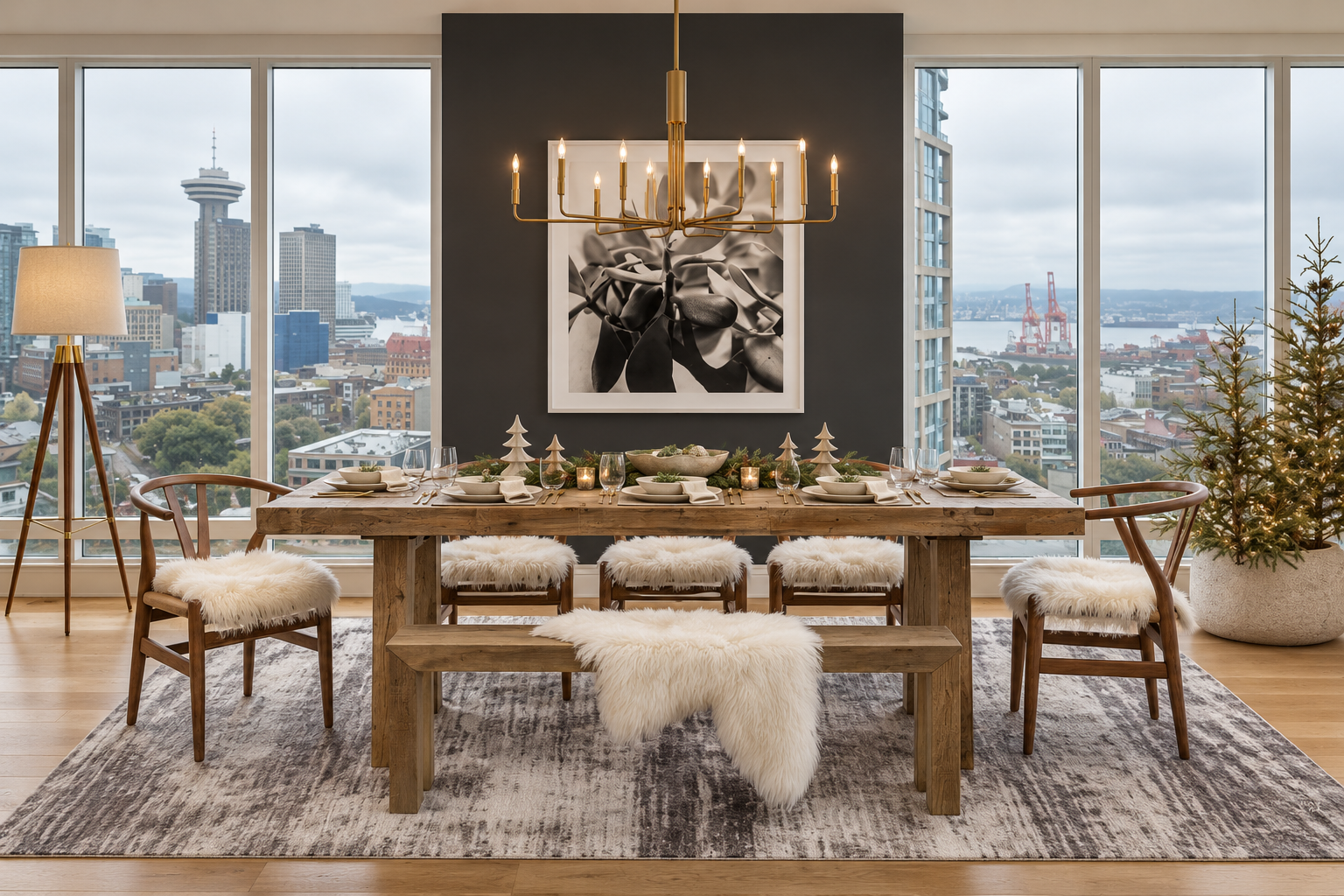
A Scandinavian and modern bohemian dining room in a high-rise condo, styled for holiday entertaining without sacrificing space for dining and conversation. Original design by virtual interior designer Joshua Jones of JJones Design Co. AI-generated rendering created from Joshua’s 2D design concept.
9. Decorate the Dining Room Without Sacrificing Function
A holiday dining room should feel special, but it still needs room for people to eat.
Start by deciding how the food will be served. If serving dishes will remain on the dining table, keep the centerpiece narrow and easy to move. If the food will be arranged on a kitchen island or sideboard, the table can support a more substantial display.
Centerpieces should generally remain low enough for guests to see one another across the table. Tall arrangements can work on a buffet or console where they will not interrupt conversation.
Instead of filling the table with small decorations, use fewer pieces with more presence. A long arrangement of greenery, a group of candles in varying heights, or several decorative trees can make a stronger impression than dozens of unrelated objects.
The light fixture above the table should also remain functional. If you hang ornaments or greenery from a chandelier, use lightweight materials, keep them away from the bulbs, and make sure they do not hang low enough to obstruct anyone’s view.
Do not overlook the dining chairs, but exercise restraint. A small ribbon, sprig of greenery, or decoration on the two end chairs may be enough. Decorating every chair can become uncomfortable for guests and make the room feel crowded.
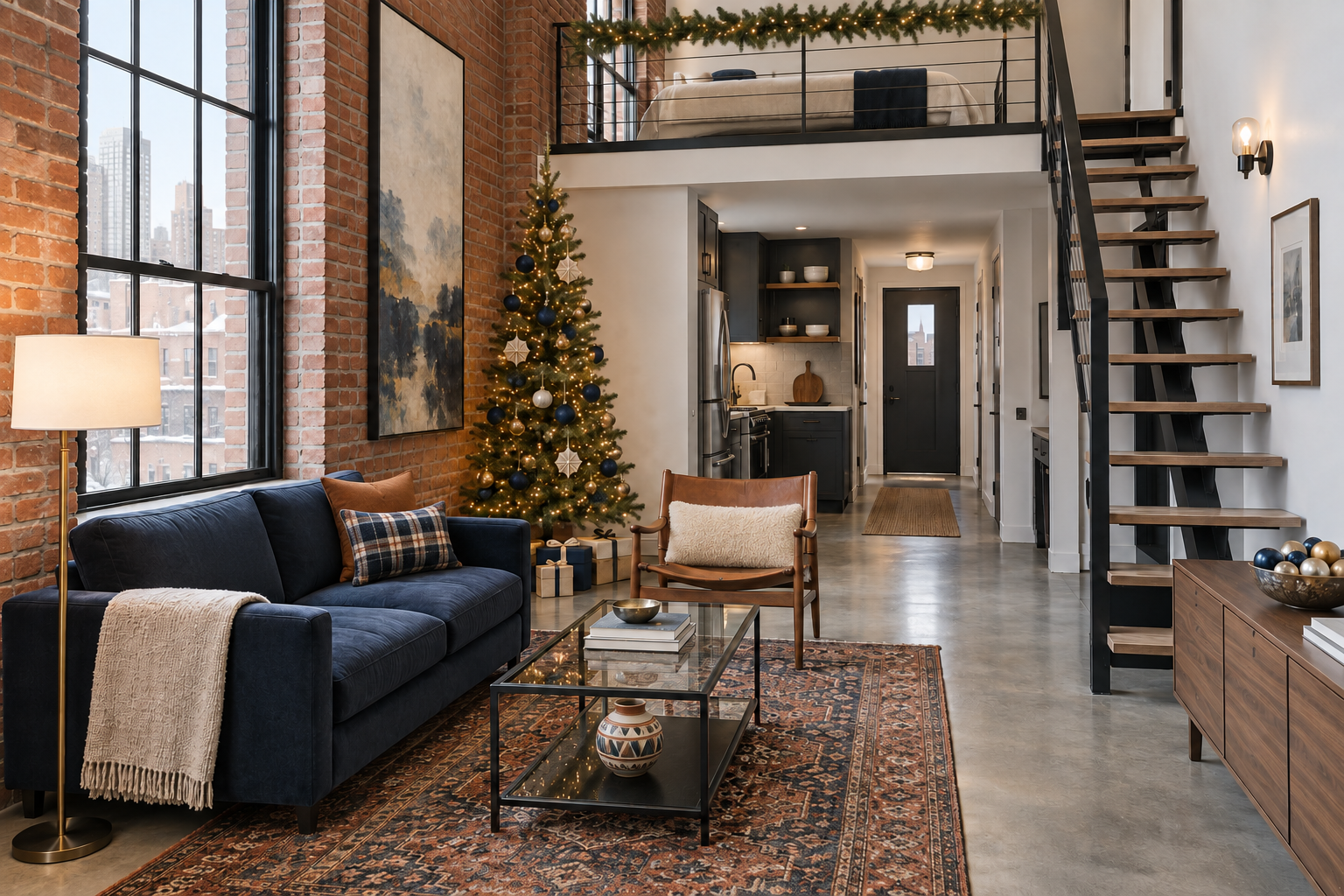
A small industrial loft made festive with a narrow Christmas tree, restrained garland, and a limited number of decorations that preserve open surfaces and walkways. AI-generated image styled by virtual interior designer Joshua Jones of JJones Design Co.
10. Make a Small Home Feel Festive, Not Cluttered
Small homes do not require miniature versions of everything. They require fewer, better-placed decorations.
Choose one main focal point rather than spreading several competing displays throughout the room. A narrow tree, tabletop tree, decorated window, or statement wreath may have more impact than many small objects placed on every surface.
Keep walkways clear and protect the surfaces you use daily. You should still be able to place a drink on the coffee table, prepare food on the kitchen counter, and open doors without moving decorations.
Vertical space can be especially useful. A wreath, tall arrangement, hanging decoration, or slender tree draws the eye upward without using much floor or table space. Mirrors and carefully placed lights can also help distribute light around the room.
Try to maintain a limited color palette and avoid strong contrast in every corner. Too many unrelated colors and small decorations visually break up a compact room. For additional ways to improve the sense of space, read my guide on how to make a small room look bigger without knocking down walls.
The goal is not to make a small home look empty. It is to give each decoration enough breathing room to be appreciated.
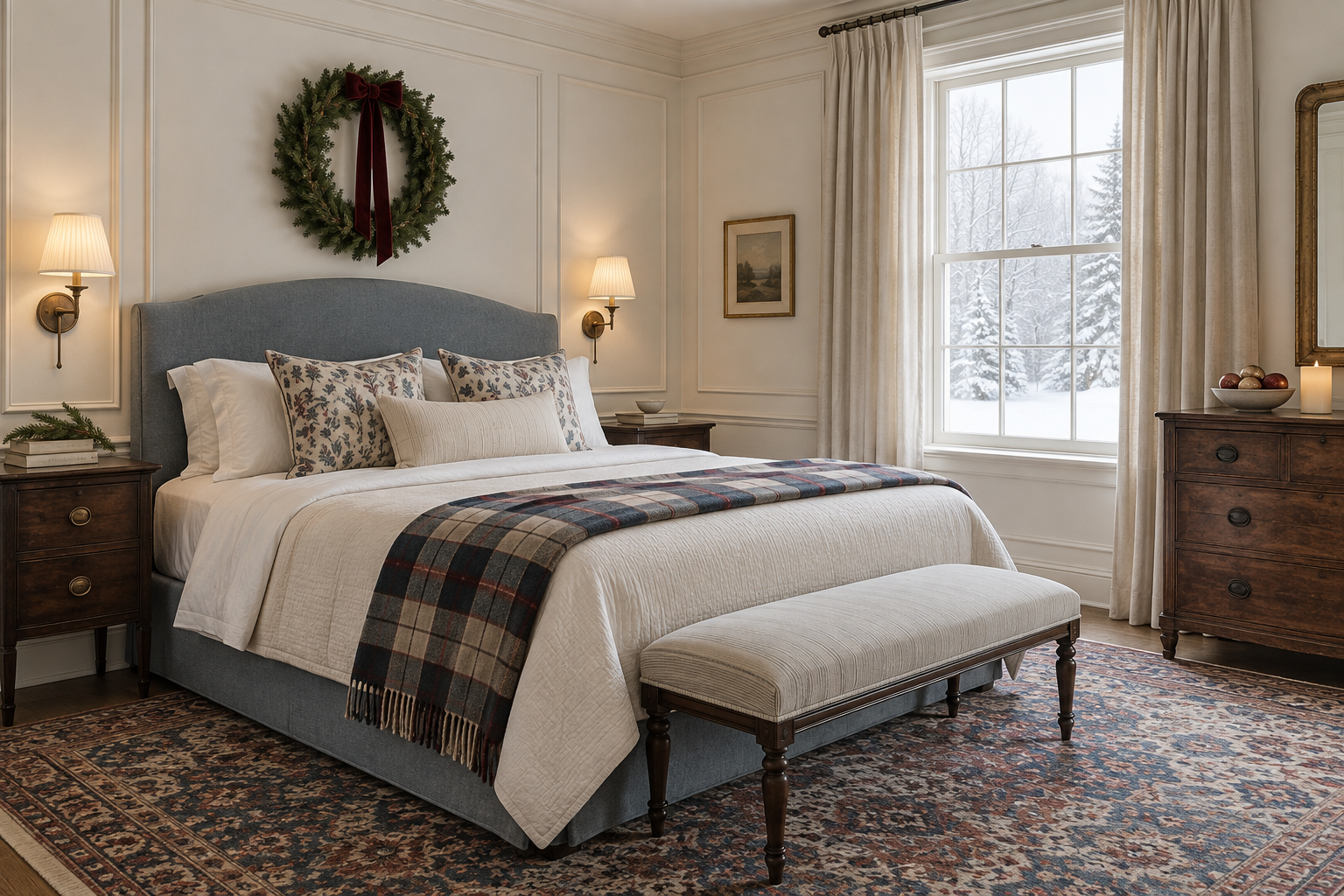
An English eclectic guest bedroom with a wreath, plaid throw, ornaments, and a small evergreen accent carrying holiday details beyond the main living spaces. AI-generated image styled by virtual interior designer Joshua Jones of JJones Design Co.
11. Carry Holiday Details Into Other Rooms
Once the main gathering areas are decorated, you can bring smaller holiday details into the rest of the home.
An entryway could have a wreath, a bowl of ornaments, or a vase filled with winter branches. In the kitchen, a small arrangement on the island may be enough. A guest room could receive a seasonal throw, a small tree, or greenery on the dresser.
These smaller moments work best when they relate to the main decorations without copying them. If you used velvet ribbon on the tree, you might repeat it on the entryway wreath. If brass appears in the living room, a brass candleholder can carry that finish into the dining room.
Bathrooms and bedrooms do not need full displays. A seasonal hand towel, candle, small branch, or single ornament may be all that is needed.
Pay attention to negative space. Leaving part of a console, shelf, or countertop empty allows the decorations to stand out and keeps the room usable. Holiday decorating should add something to the home, not make every surface more difficult to use.
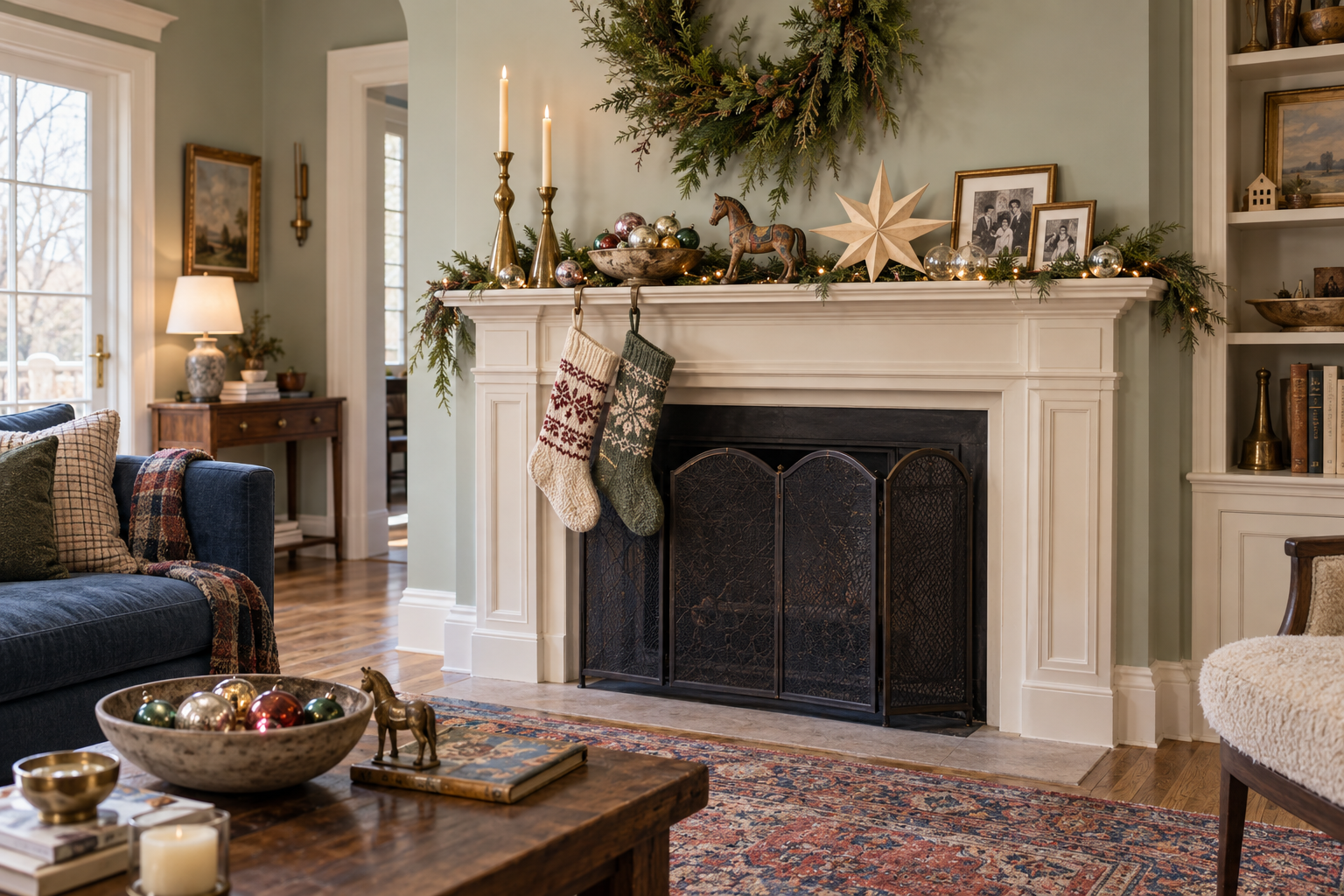
A holiday mantel combining family photographs, hand-knit stockings, vintage ornaments, and a wooden horse with newer greenery, glass accents, and brass candleholders. AI-generated image styled by virtual interior designer Joshua Jones of JJones Design Co.
12. Mix Sentimental Decorations With Newer Pieces
Some of the most meaningful holiday decorations will never coordinate perfectly with a carefully planned color palette—and that is completely fine.
Handmade ornaments, family decorations, inherited pieces, travel souvenirs, and items collected over many years give a home its personality. Without them, holiday decorating can begin to feel more like staging than living.
The key is deciding how to display them.
You might group family ornaments together on one part of the tree, use inherited pieces on a dedicated shelf, or allow one collection to become the focal point of a room. A shared background, tray, ribbon color, or group of similar frames can help unrelated objects feel connected.
You can also rotate decorations. Not everything has to come out every year. Changing which pieces you display gives older decorations renewed importance and prevents the home from feeling overfilled.
New decorations should fill a genuine gap rather than replace the character you already have. Before buying anything, ask whether it adds something different, works with your existing collection, and has a clear place in the home.
A beautifully decorated holiday home should reveal something about the people who live there.
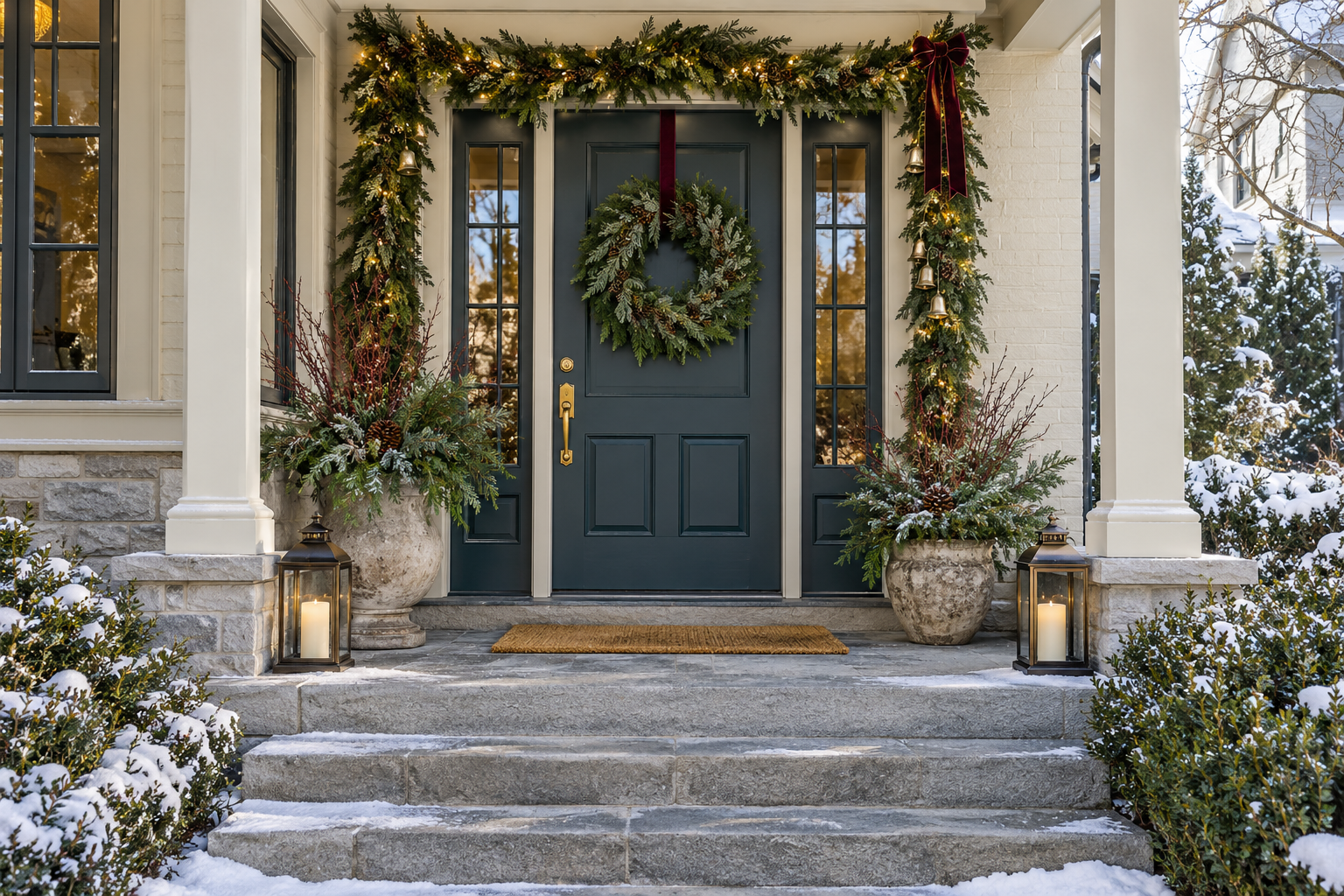
An elegant holiday entrance with evergreen garland, a natural wreath, winter planters, brass bells, warm lights, and a clear, welcoming pathway. AI-generated image styled by virtual interior designer Joshua Jones of JJones Design Co.
Holiday Decorating Mistakes to Avoid
Even beautiful decorations can work against a room when they are used without considering scale, function, or the rest of the home. These are some of the most common mistakes I see:
Decorating every available surface: Empty space gives your eye somewhere to rest and helps the decorated areas receive more attention.
Using too many unrelated colors: Choose a limited palette and repeat it throughout connected spaces.
Ignoring the scale of the room: Decorations that are too small can look scattered, while oversized pieces can overwhelm furniture and walkways.
Blocking how the room functions: Keep doors, vents, seating, work surfaces, and conversation areas accessible.
Depending on one light source: Layer holiday lights with lamps and other ambient lighting so the entire room feels welcoming.
Trying to use everything you own: Rotate decorations and keep some items in storage when the room already feels complete.
Following a theme too literally: A decorating style should guide your choices, not make your home feel like a themed retail display.
Removing everything personal: Sentimental decorations are often the pieces that make the holidays feel most meaningful.
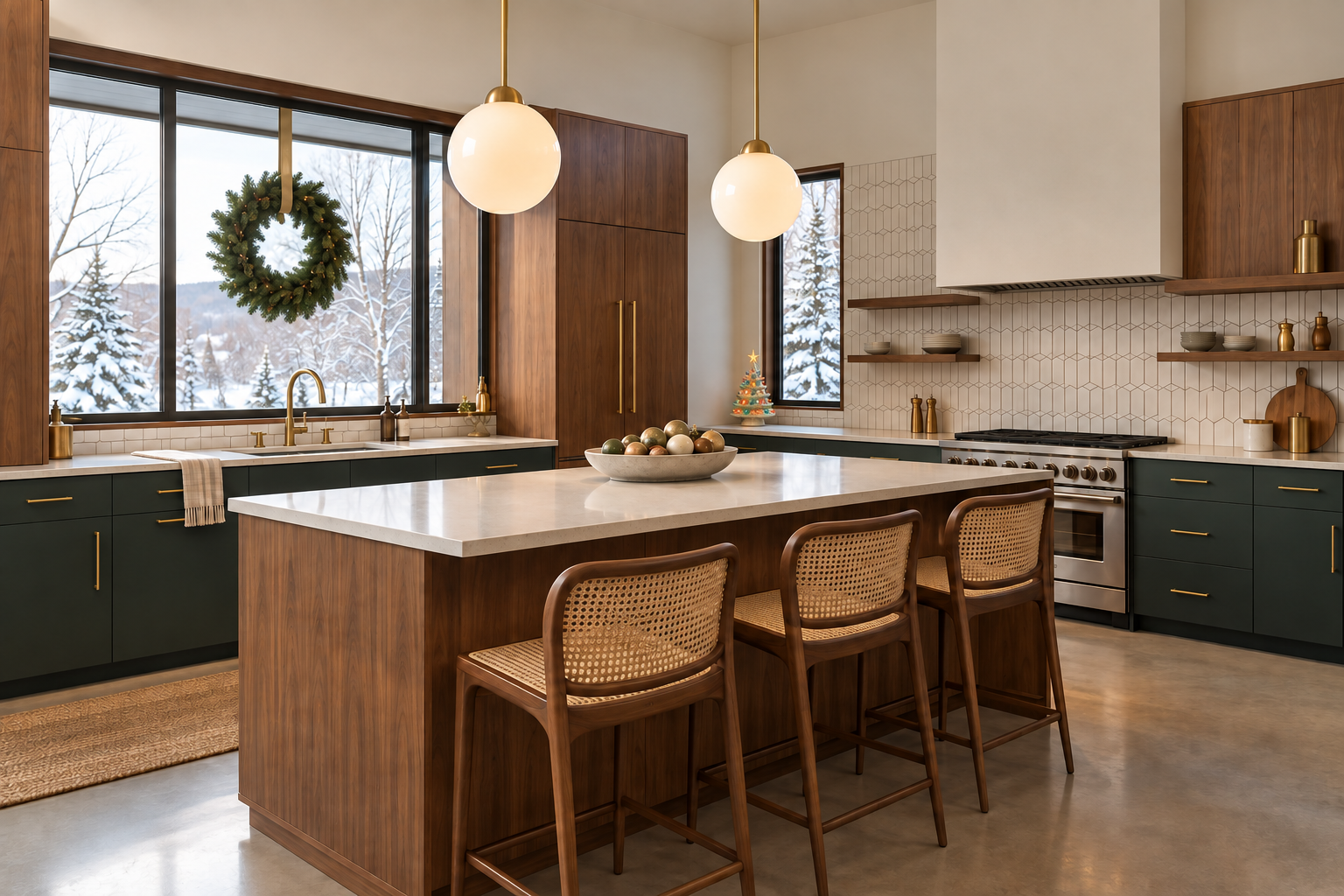
A bright mid-century modern kitchen decorated for the holidays with a natural wreath, vintage ceramic Christmas tree, and a bowl of coordinated ornaments. AI-generated image styled by virtual interior designer Joshua Jones of JJones Design Co.
Frequently Asked Questions About Holiday Decorating
Where should I begin when decorating my home for the holidays?
Begin with the rooms where you spend the most time and identify one main focal point. Establish your style and color palette before placing individual decorations. This gives you a clear direction and reduces the temptation to decorate every surface.
How many colors should I use in my holiday decorations?
Two or three main colors usually provide enough variety without making the home feel busy. You can add depth by using several shades, materials, and finishes within that palette.
Do my holiday decorations need to match my interior design style?
They do not need to match exactly, but they should work with the colors, scale, and overall atmosphere of your home. Holiday decor is most successful when it feels like a seasonal extension of the room rather than a completely separate design.
How can I decorate for the holidays without using traditional red and green?
Begin with colors already found in your home. Blues, warm neutrals, burgundy, plum, bronze, silver, white, and natural wood tones can all feel festive. Greenery can provide a seasonal element without requiring a traditional red-and-green palette.
How can I keep holiday decorations from looking cluttered?
Use fewer decorations with greater visual impact, concentrate them around key focal points, and leave open space between displays. Remove some everyday accessories temporarily instead of placing holiday decorations around everything already in the room.
How can I decorate a living room that does not have a fireplace?
Use the tree, a console, bookcase, large window, media wall, or artwork as the focal point. Add layered lighting, textiles, and a controlled amount of greenery to create warmth without needing a mantel.
How can I decorate a small apartment for the holidays?
Choose one main display, use vertical space, maintain clear walkways, and avoid covering essential surfaces. A tabletop tree, narrow tree, statement wreath, or decorated window can make the apartment feel festive without taking over the room.
When should I stop adding decorations?
Step back and look at the room from the entrance. If your eye does not know where to land, everyday activities have become difficult, or individual decorations are disappearing into the display, it is time to remove a few things.
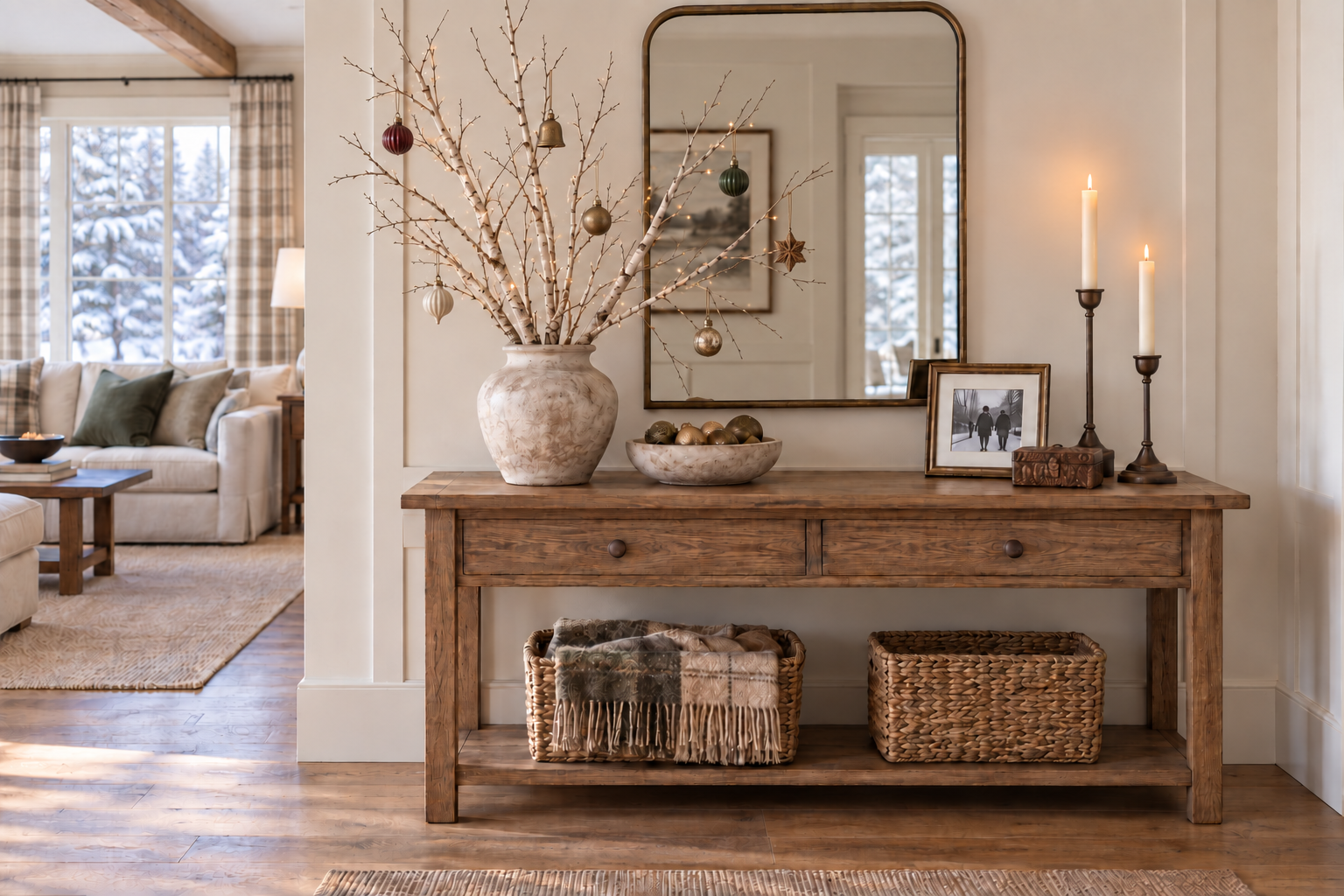
A modern farmhouse console styled with illuminated birch branches, collected ornaments, family photography, woven baskets, and meaningful decorative pieces. AI-generated image styled by virtual interior designer Joshua Jones of JJones Design Co.
Create a Holiday Home That Feels Like Yours
There is no single formula for the perfect holiday home. Some people enjoy rooms filled with color, family collections, and decades of memories. Others feel most comfortable with greenery, warm lights, and a few carefully chosen decorations.
What matters is that the home supports the way you celebrate.
Begin with what you already have, decide where your effort will have the greatest effect, and give your most meaningful decorations room to be noticed. When every choice has a purpose, the finished home will feel festive without losing the personality it has during the rest of the year.
If you would like professional guidance creating a home that works beautifully during the holidays and throughout the year, learn more about my virtual interior design and decorating services.
